


Abstract
This article is based on a presentation given at the HYDRO18 Conference in Sydney and is reproduced with kind permission.
Background
The Australian Government is currently considering a similar shift towards a more comprehensive contracted industry hydrographic survey supply (IHO, 2018). This paper shares DML’s experiences, observations and insights from the last 10 years as a provider of similar services to the New Zealand (NZ) government. The authors have summarized these in the form of 10 key tips for developing a sustainable, proficient and efficient hydrographic survey business to support the nautical charting market.
1. Define a clear brief
The key to any successful project starts with a clear and concise project brief. In the case of complex nautical charting surveys, the brief should establish clear requirements for the contractor to address, in particular whether the task relates to safety of navigation or science. It’s important for the contractor to understand what must be achieved, what elements are critical and why, what specific deliverables are required, when they are required and in what form. Defining clear requirements also ensures that deliverables will be fit for purpose for all stakeholders.

There may be instances where the best deliverable that typically demands a premium price is not warranted. As a contractor to government, DML has been conscious of ensuring work area allocation makes sense, without accumulating line miles for the sake of it. The trust that is established from this attitude is invaluable.
Once the survey requirements are clearly defined, it becomes easier to gain agreement from stakeholders on what datasets are required and what takes priority. Where multiple stakeholders have contributed to project funding, tensions can arise around operational protocols and priorities. In DML’s opinion, capturing the priority dataset should define the lead contracting authority.
2. Don’t pay lip service to stakeholder engagement
From experience, DML has seen that the best project briefs are developed collaboratively. This provides the opportunity to not only validate the questions but also explore possible operational and project challenges, opportunities for innovation and project efficiencies. Clients and suppliers should engage early with other stakeholders. Engagement must be genuine, inclusive, honest and respectful. You never know where the light-bulb moment will come from.
A huge benefit in early stakeholder engagement under LINZ’s new supplier panel arrangement has been recognized. DML has participated in project reconnaissance which has directly impacted the project brief and specifications. There has been the opportunity to share our field experience to help unlock efficiencies and avoid project complication. Consulting industry early in the planning process also avoids suppliers feeling locked out and ensures the buyer is fully informed of any possible project roadblocks.
In software development, Linus’s Law (Raymond, 1999) claims “given enough eyeballs, all bugs are shallow”. With multiple stakeholders demanding a variety of deliverables this also becomes true of early engagement and development of the project brief.
3. Define the specifications clearly
It seems obvious that defining clear specifications is as important as a clear project brief, but there is not always a straightforward answer in multidisciplinary surveys. Hydrographic specifica- tions for surveys and navigation products are well defined and understood internationally by industry.
By contrast, specifications around the capture of non-bathymetric datasets appears to vary between national agencies and is often dependent on the science questions being asked. These questions may not be the same for all locations within a project’s geographic extent. In the case of acoustic data from MBES systems, there are well documented operational science guidelines. From what we have seen of these guidelines in practice in New Zealand, the science guidelines do not appear to define the quality of the product and are focused on operational inputs rather than final outputs.
Stakeholders agreeing on the science specifications is important, but of equal importance, is establishing which data set within the total project specifications is to take priority. This is key to field survey operations as there are likely to be several environmental factors and project constraints that may influence contractor decisions relating to data priorities e.g. bathymetry versus backscatter versus water column.
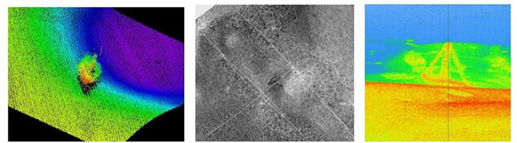
Figure 2: Bathymetry, backscatter and water column data over a wreck
4. If there is a need to trial new processes, validate early or fail fast
Industry moves quickly on technological advancements which are often not allowed for or covered in initial project briefs. Software upgrades can often happen halfway through a project. If the contractor identifies potential client benefits in trialling new equipment or solutions, then they must alert the client to this, have a defined process for validating them and/or fail fast strategy, allowing the project to proceed to an agreed Plan B.
Sometimes project timelines or constraints won’t accommodate the flexibility for trialling new capability. However, for industry solutions to continually improve, there must be an openness to trials during ‘real projects’ when conditions permit. For a supplier to feel safe in doing this, the client must adopt an attitude that allows trials, specifically where failures are acceptable. Without this attitude fear will pervade and innovation will be stymied.
Contractors should not be afraid of proposing alternatives, so long as both parties are prepared to share the risk of failure.
5. Procurement model, panel or contestable?
Value-for-money underpins all government contracts. Recent trends towards panels of providers as opposed to contestable “winner takes all” contracts are attempting to create a win-win for both the client and suppliers.
When considering a panel, it’s important from a contractor’s perspective, not to over stack the panel. There’s a real cost in being fit and ready to set to work at any moment. Expecting suppliers to be on standby without providing them with enough work is not sustainable for suppliers. Instead it’s better to assess the available budget and work backwards to determine what level of contractor support is required for the short to medium term. It’s unrealistic to expect industry to gear up in anticipation of work and then hold tight. In New Zealand, LINZ addressed this issue by understanding that annual budgets were probably only large enough to support two contractors. As such, their panel consists of two companies who are working collaboratively to ensure that they both derive enough income in any given year to support panel participation and deliver client requirements including sustainable capability and innovative solutions.
LINZ has also offered multi-year contracts to suppliers providing increased income certainty. This has helped suppliers justify their business cases for ongoing investment in evolving technologies and has also addressed very critical human factors within the industry. Hydrographic surveying is a challenging career that requires teams to be away from home for extended periods, often working long hours in remote locations.
People need security. Multi-year contracts provide increased income security for businesses which directly affects their people. It’s untenable to expect staff to make the necessary lifestyle sacrifices that come with being a hydrographic surveyor and not compensate for this with adequate income security.
6. Get the contracting model right
For complex projects that involve several client stakeholders it’s important to have clarity around who the client is and who the contractor is. LINZ shield contractors from multi-client environments by acting as the representative and legally bound buyer of all services. This prevents a situation where the supplier is drawn into conflict over competing priorities. It also ensures that there is a clear line of communication for contract negotiations and operations.
LINZ’s approach has also ensured that contract documentation and specifications are simple and direct by acting as the lead client when multiple clients exist. The supplier should only be accountable to one contract document.
Where a project requires input from various contract suppliers, it’s vital that there are clear lines of accountability on the supply side and that there is a clear project lead. The client will appreciate a singular point of contact.
It’s important not to overburden projects with too much red tape, lawyering up costs everyone. To achieve the efficiencies that are available in an industry supply model, the buyer must be agile. This requires some customization ensuring contracts are fit for purpose and not a “one size fits all” approach. A contract that’s designed for the procurement of an all of government consultancy service, will be overwhelming for a SME hydrographic survey supplier responding to a sub $5M project. Efficiencies will also arise if government establishes processes that enable uncomplicated delivery of quality line miles, not contract administration. SMEs by nature are not complex entities. Burdening them with the complexity that can exist within government processes, will rapidly erode any efficiencies being sought from industry.
Project risk must also be sized appropriately. Is it fair to burden a contractor with project risk for something that they have no control over such as weather? Or ask that insurances are held that would indemnify the buyer for a replacement vessel rather than a 10-day project. Insurances can be a minefield where industry ends up establishing cover, for cover that is ultimately already in place by government. Essentially double-dipping.
7. Develop a framework that encourages collaboration
Under a healthy panel of providers’ environment, it is possible to remove fear from the table, a powerful notion for a small business. If the panel is sized appropriately for the market, trust between the client and panel members increases. There is space for discussion around innova- tion and development in frank, material ways.
There are also benefits to be gained from ensuring budgets are transparent. In our experience focus shifts to finding smarter more cost-effective ways to deliver outcomes, reserving budgets for future projects. Without this transparency, there is temptation to build in additional contingen- cies or margin in case there is a lean period ahead that the supplier must prepare for.
Being part of a panel has allowed DML to consider the treatment of weather downtime differently. We share weather downtime budgets with LINZ, refunding unused allowance for additional line miles as we approach the project completion. A win-win scenario for both organizations.
For the first time in 10 years, DML is collaborating with a competitor in a healthy manner which has resulted in better asset utilization and more productive outcomes. We are planning to share vessels to avoid duplicating mobilisation costs, working on the same project to achieve a faster project delivery and jointly develop process innovations to provide more efficient project outcomes.
8. Establish realistic timeframes for all aspects of the project
It’s important to understand lead times for contract negotiations and contract signing and how this may affect operations. Don’t allow this period to creep into seasonal weather windows for vessel operations. Outside stakeholders may not appreciate the urgency in getting projects underway to be completed within a seasonal weather window. This can impact on project risk or completion.
Funding and budgetary time frames need to be considered along with progress payments. There are inherently many upfront costs businesses must fund to initiate a project and this should be reflected in the payment schedule milestones. It’s unrealistic to seek the efficiencies that an SME can offer, and yet expect them to bankroll large projects. Cash flow risk can be mitigated by prompt progress payments. Cash is king.
9. Have the right people, doing the right things
Hydrographic surveying is an applied science where the benefits of field experience cannot be underestimated. In our experience, not all IHO Cat A or AHSCP Level 1 hydrographic surveyors are born equal. It takes significant time in the field working on complex nautical charting surveys to be fully competent to deliver a quality project. This knowledge or training is currently acquired in-house working for companies that are doing this type of work. We have seen large gaps in knowledge irrespective of certifications. Some gaps are technical by nature and/or operational such as experience in managing people, vessels and technology in challenging environments. These gaps can arise in both the supplier’s and client’s teams.
Our advice is to ensure that people are adequately tested in a supportive environment before allowing them to lead major projects. This will prevent unnecessary errors or project stress. We undertake exchanges with LINZ where we work alongside each other to observe, understand and develop streamlined processes together. We recently worked to develop protocols for S-57 encoding (IHO, 2000) and are actively refining ancillary deliverables using a draft specification version.
Exchanges have enhanced our relationships and improved communication by having more direct communication pathways. For example, our Surveyors in Charge will talk directly to the client representative regarding operational matters and enabling them to achieve timely responses.
Having depth in your team is also vital. Staff burn-out will be a major issue if you over burden team members. No project can survive when relying on one key person. It’s important that every role has a backup. As an SME, this may be a simple matter of training several people to have broad skill sets rather than a singular role.
10. Accept that compromise is unavoidable when dealing with multiple stakeholders
Competing demands by multiple stakeholders with different sized budgets requires compromise. While not all survey objectives may be known at the start of a project, if there is common agreement on a basic set of national data capture standards and deliverables, then the cry of “capture once, use many” can be delivered upon. In the case of New Zealand and Australia where the areas of responsibility for nautical charting and marine science are some of the largest in the world, the statement “some data, is better than no data” has significant bearing.
11. Conclusion
Since 1997, LINZ has been on a 20-year journey of outsourcing hydrographic services. Discovery Marine Ltd (DML) joined that journey in 1997/98 as LINZ’s Quality Assurance representative for the first contestable nautical charting survey undertaken by LINZ – 97/98 3HS Kaikoura Survey. In 2007, the company started providing full nautical charting survey services to LINZ and has been a regular supplier ever since.
DML has experienced troubled times during a period of highly competitive contracting model. With the establishment of a panel of two providers in 2016/2017, LINZ has dramatically changed the way it does business with contractors.
The experiences by both contractor and client over the last 20 years have laid the foundation for a well performing panel. It seems only fitting that Kaikoura was the location for the first outsourced nautical charting survey journey beginning in 1997 and that this location was used again for another key milestone in 2017 – undertaking a comprehensive multidisciplinary survey.
12. References
IHO (2000). Transfer Standard for Digital Hydrographic Data (S-57), Edition 3.1, International Hydrographic Organization, Monaco.
IHO (2018). Australian Defence Project SEA 2400 PHASE 1 HydroScheme Industry Partnership Program (HIPP) Tender, The International Hydrographic Review, 19 pg. 61, International Hydrographic Organization, Monaco.
Raymond, E. S. (1999). The Cathedral and the Bazaar, O’Reilly Media. Sebastopol, USA.
13. Biographies
Declan Stubbing,
B.Surv, MNZIS, CPHS1 Survey Manager
Declan leads Business Developement and R&D for DML. He has extensive technical experience in delivering complex surveys and enjoys finding innovative solutions for clients. His knowledge of system capabilities is extensive and ensures he stays abreast of technology innovations that present new possibilities for clients.
Declan qualified from Otago University with a Bachelor of Surveying (B.Surv) specialising in Hydrographic Surveying. He’s completed the IHO FIG Cat A course and also holds CPHS Level 1 certification. Declan is a qualified mariner, holding an Inshore Launch Master (ILM) certificate and is a member of the New Zealand Institute of Surveyors (NZIS).
As one of DML’s senior surveyors, Declan has led complex nautical charting surveys for the New Zealand Government, supported intensive dredging campaigns and is often lead surveyor for DML’s local and off-shore projects.
E-mail: declan@dmlsurveys.co.nz
Kevin Smith
Business Manager
Kevin is the Business Manager for Discovery Marine Ltd (DML) based in Tauranga, New Zealand. He has a 36 years’ experience in hydrography and IT stemming from roles in the RNZN and private industry. Over the years he has worked in New Zealand, Australia, the South Pacific, Seychelles, Canada, and the UK. Since leaving the RNZN in 1997 he has been involved with companies providing hydrographic services to Land Information New Zealand (LINZ) and wider industry.
As DML’s Business Manager, he has participated in a number of LINZ Nautical Charting survey contracts, typically in a variety of roles including contract manager, project manager, IT support, MBES data processor and survey support.
Kevin is a member of the Australasian Hydrographic Society (AHS), Chairman of the AHS Awards Panel, Chairman of the AHS NZ Branch and a Member of the New Zealand Institute of Surveyors (NZIS).
E-mail: kevin@dmlsurveys.co.nz
Sally Cox
Director/Strategy
Sally Cox is a Director of Discovery Marine Ltd (DML) and also guides company governance and strategy. As a non-surveyor, she provides an alternative perspective to company development. Her business experience provides a comprehensive understanding of most business functions and can dive in to business requirements as needed.
Sally keeps the DML team focused on the company’s strategic intent ensuring it will remain meaningful for clients and that the company continues to achieve its goals. She also helps in developing strategic alliances with collaborative partners.
Sally holds a BMS in marketing and management accounting and has had an extensive ‘other career’ helping build businesses, brands and bold ideas.
E-mail: sally@dmlsurveys.co.nz