
Abstract
1. Background
The DHDB was acquired under the auspices of Project SEA1430 Phase 1 in 1999. The DHDB was formally accepted by the Commonwealth of Australia in October 2004. However, Interim Operational Release (IOR) was deferred pending completion of contractual requirements. Acceptance into operation was finally achieved in 2011 and DHDB evolutionary sustainment activities commenced. A new maintenance contract was signed in 2013 with BAE Systems Australia Ltd.
The majority of the DHDB technical solution dated back to 2004 technology and by 2011 was obsolete, bespoke and incapable of supporting the exponential increase in digital archive and information management required by the AHS to support contemporary requirements. This was further compounded by upgrades in both RAN and national port data collection capabilities along with the requirement to update a much larger number of paper and electronic chart products.
DHDB capability shortcomings led to the development of several internal work-around solutions. This resulted in an operating environment comprising multiple non-integrated networks and systems, mixed software technologies, bespoke solutions, inconsistent workflow operations and minimal training opportunities for existing and new staff – all leading to inefficiencies in all activities.
2. AHS Responsibilities
A re-engineered, effective and efficient DHDB is a fundamental technology enabler for the AHS to deliver assured information, products and services that meet Australia’s obligations under UNCLOS and SOLAS Chapter V Regulation 9, the Navigation Act 2012 and for the supply of maritime military geospatial in- formation to Defence. The RAN is the national authority responsible for the work required to meet Australia’s international commitments for the provision of hydrographic products and services within the Australian Area of Charting responsibility.
The Navigation Act 2012 confirmed the requirement for the AHS, as part of the RAN, to collect, compile and collate, maintain and disseminate hydrographic and other nautical information as required under international conventions.
The Defence White Paper 2013 reiterated the future hydrographic capability must provide maritime military geospatial information out- puts to support the following activities:
- Understanding and shaping Australia’s strategic environment;
- Conducting combined joint combat operations;
- Conducting peace and stability operations;
- Providing Defence support to whole-of- government domestic security;
- Providing humanitarian assistance and disaster relief at home and overseas;
- Providing specialist support (domestic and overseas);
- Evacuating non-combatants; and
- Undertaking recovery operations.
3. Hydrographic Information and Production Initiative (HIPI)
When the DHDB came under a sustainment agreement between the RAN and the Defence Materiel Organisation (DMO), a number of tasks were undertaken to immediately refresh lagging core capabilities. These included upgrading the hardware environment, operating system, replacing the DHDB workflow software and updating the production tools to support S57 Ed 3.1 sup 2. An investigation also commenced into the potential for CARIS HPD to replace the existing DHDB CARIS GIS and other third-party software tools used to produce ENCs and paper charts. These investigations included site visits to Land Information New Zealand (LINZ), Canadian Hydrographic Service (CHS) and the United Kingdom Hydrographic Office (UKHO) to understand how they were implementing contemporary solutions.
In 2013, the Hydrographer of Australia (CDRE Brace, RAN) appointed a technical team to lead and coordinate evolutionary sustainment activities to improve existing systems and processes. This work item was titled the Hydrographic Information and Production Initiative (HIPI). The core technical team is very small with several team members also managing daily management and production operations. Other AHS staff and technical contractors are brought into the team to participate in sustainment tasks for various system components. This allows AHS staff, who will eventually be using the sustained systems, to have a high level of ownership and authorship in the way that the sustained systems will operate. This significantly improves the transition from concept to requirements, to testing and then implementation. The adopted strategy for implementing the change process is based on the Eight-Stage Change Process described by Kotter (2012).
The timeframe for completing the evolutionary sustainment of existing DHDB systems is late 2017. HIPI is assisting the DMO to achieve the CN29 sustainment program by implementing AHS Leadership Group strategic objectives and business-driven activities. The evolutionary sustainment activity encapsulates coordinated views of the organisation using an Enterprise Architecture (EA) approach. These views encompass strategy, business and technology.
As described in OMB (2012), Enterprise Architecture means a strategic information asset base which defines:
- the mission;
- information necessary to perform the mission;
- technologies necessary to perform the mission;
- transitional processes for implementing new technologies in response to changing mission needs; and
- a baseline “as is” architecture, a target “to be” architecture and a sequencing plan.
The sustainment of the DHDB will be used as a benchmark EA Program (EAP) and will align and unify overall organisation strategic initiatives, business processes, information flows, systems and services, technology infrastructure and organisation structure. The EAP will strive to:
- Involve stakeholders at all appropriate levels throughout the AHS enterprise. These steps are essential to achieve maximum buy-in and ongoing support of the program;
- Invest in technologies that will fully sup- port its Mission, Vision, and Strategic Objectives;
- To improve information sharing, AHS will invest in Commercial Off-The-Shelf (COTS) and non-proprietary products that emphasise open standards and heterogeneity;
- Allow for optimal planning whether it be a top-down or bottom-up approach by bringing together different perspectives of business and technology throughout the enterprise. Decision-making capabilities are enhanced by providing comprehensive views of current capabilities and re- sources while keeping in mind a number of future scenarios that may require changes in processes and resources;
- Enable improved communication through- out the AHS. Open information sharing and the wealth of knowledge provided by the EA repository allows on-demand access to current and pertinent information to best support the AHS.
4. Scope of Sustainment Activities of the EAP
The key sustainment processes are:
- Identify the key Lines of Business (LOB) within the AHS in terms of the current DHDB capability;
- Model the “as is” state of the initial SEA1430 Phase 1 DHDB components and the work-around capabilities that were introduced to overcome DHDB shortcomings;
- Model the “to be” state to meet current and perceived future strategic requirements;
- Describe and implement the transition stages to move from the “as is” to the “to be” states.
- Sustain and maintain the EAP using the AHS Quality Management System (QMS).
4.1 Enterprise Architecture (EA) Core Elements
The HIPI approach to EA requires six core elements to exist and work together as shown in Figure 1:
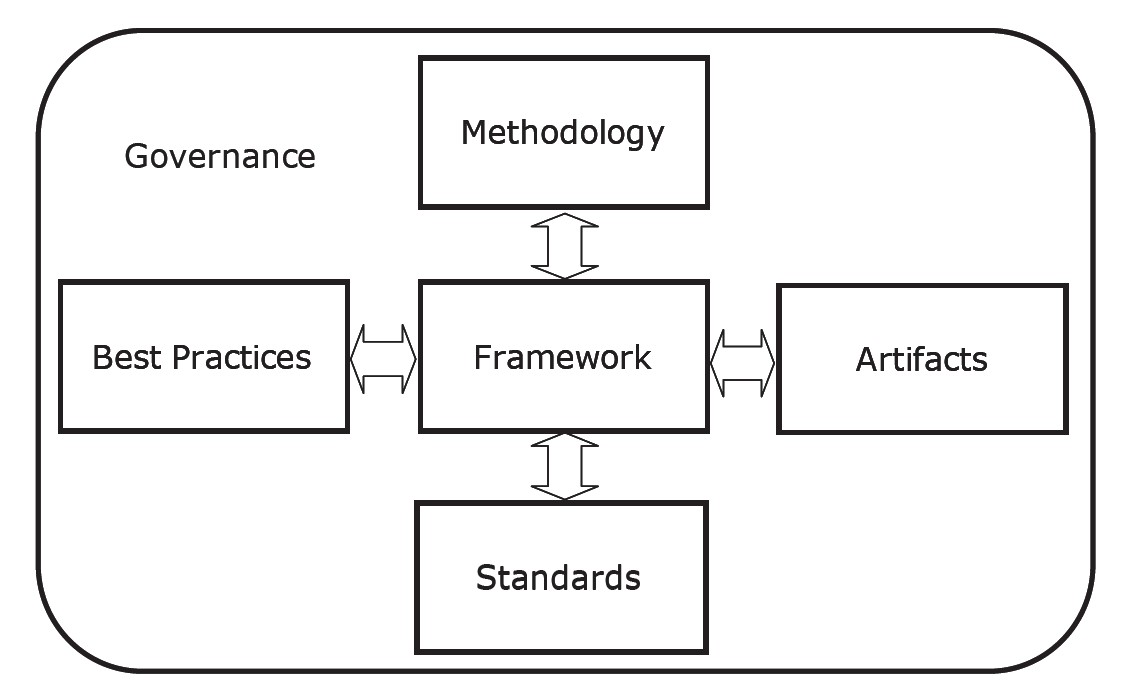
- Governance: Conformance of the HIPI EA process to the overall AHS planning, decision-making and oversight processes and groups in accordance with the AHS QMS;
- Methodology: Specific steps to establish and maintain the EA program;
- Framework: Identifies the scope of the overall architecture and the type and relationship of the various sub-architecture levels and threads;
- Artifacts: The documentation supporting the EA process;
- Standards: The business and technology standards for the AHS in each domain, segment and component. This includes all relevant standards impacting the operations of the AHS;
- Best Practices: These are proven ways to implement parts of the overall architecture, in the context of the over-arching EA;
4.2 Enterprise Architecture (EA) Framework
HIPI has adopted a hierarchical EA Framework described by Bernard (2015) shown in Figure 2:
- Goals and Initiatives – high level strategic goals and initiatives of the AHS;
- Business Products and Services;
- Data and Information flows;
- Systems and Applications – the information systems and applications used to deliver IT capabilities;
- The required Networks and Infrastructure – the connectivity grid of the architecture;
- Lines of Business (LOB) with distinct business activities and resources;
- Artifacts – documentation;
- Threads including Security, Standards, Skills (competency) and Organisation.

4.3 Performance Measures
For each sustainment activity, performance measures are identified. Sustainment outcomes will provide measurements of the improvements to the sustained system component. Examples of performance measures include:
- Overall reduced number of enterprise software and database applications – the number of software applications, plug- ins, and extensions at the commencement of sustainment was 360 and has already reduced to 110;
- Improved component integration;
- Improved workflow operations;
- Improved quality assurance of products and services;
- Reduction in data and product error rates;
- Increased application end-user satisfaction;
- Improved customer response;
- Improved IT investment decision-making such as utilisation of shared Defence ICT capability (e.g. Primary Data Centres) and leveraging off other Defence projects;
- Improved systems’ maintenance processes;
- New capabilities that weren’t present or mature when the DHDB was first implemented (e.g. web services, e-commerce, etc.) and external interfaces (e.g. internet gateway access for data, product and service offerings);
- In conjunction with DMO, meet the contractual budget requirements.
5. AHS Lines of Business (LOB)
The primary Lines of Business (LOB) to be addressed within the evolutionary sustainment activities are shown at Table 1:
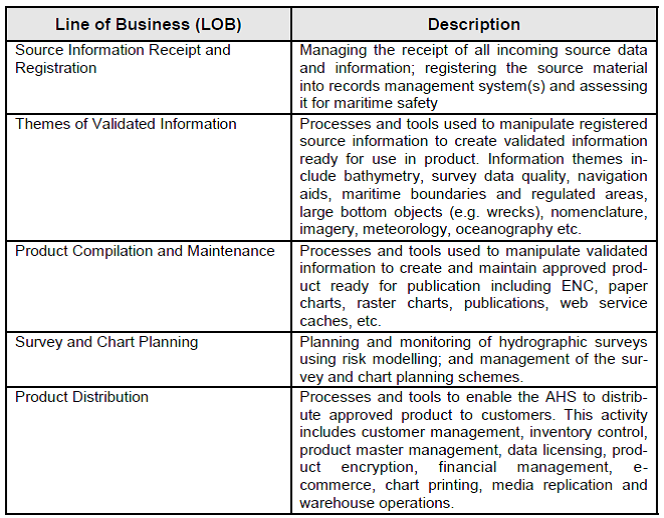
Within each primary LOB, there may exist separate LOBs having their own specific requirements but sharing common requirements of the primary LOB. For example, the Product Distribution area is a LOB. However the various operations such as data licensing, chart printing, customer management, etc. may be undertaken using different software tools, processes, workflows, etc. within the context of the specific activity and its information.
5.1 Source Information Receipt and Registration LOB
The AHS currently has several separate sections managing incoming information. Most of this data is managed within each section’s file management solutions and/or the official document records management system (DRMS).
Key requirements are:
- Enable legal traceability of data, information and product records;
- Meets the necessary key (if not all) accreditation criteria to Commonwealth of Australia records policy;
- Provides a single point of information receipt within the AHS – all geospatial information coming into the AHS goes to one place for receipt, acknowledgement, registration, assessment for navigational safety impact, and distribution. The AHS may have one or many incoming conduits, but only one registration point. Multiple users can view incoming correspondence but cannot access it until it has been registered in a compliant records management system;
- No duplication of data and information in the records management system although records can be replicated as required;
- Business process workflow tools to model and manage the flow of information through defined quality assurance activities, validation rules, decision points, etc. for receipt, replication, extraction, registration (including metadata content, geospatial location tagging), storage, archive, disposal, promotion, alerts, etc.
- The system will provide geospatial data discovery tools – search, query, display, report and output in appropriate formats;
- Metadata conforming to the ISO 19115 metadata standard.
5.2 Validated Information Theme LOBs
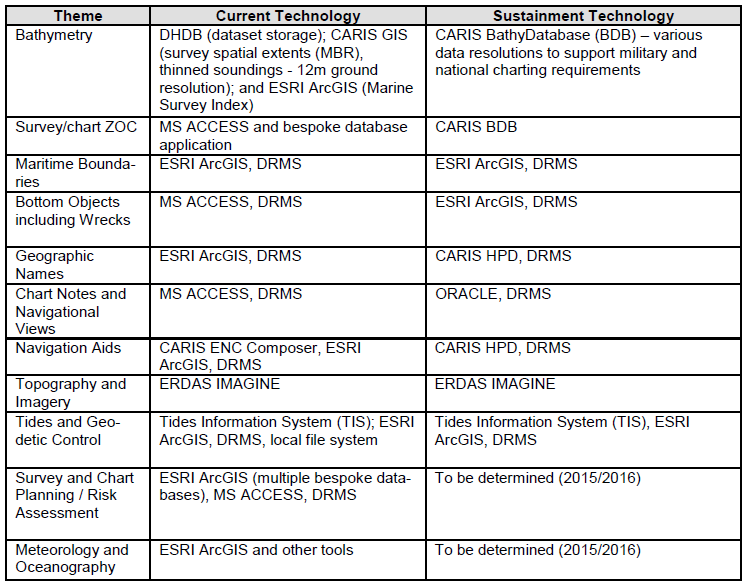
Validated Information Theme LOBs are currently managed across various AHS sections using various technologies as shown in Table 2.
Key requirements are:
- Reduce the number of existing software systems and tools used across the organisation where possible;
- Use the best tool for managing the appropriate validated information theme;
- The system will use only “registered” information and provide the appropriate tools for staff to process the information to create a “validated” set of data that can be used for further activities (i.e. chart production, publications, etc.)
5.3 Product Compilation and Maintenance LOB
The Product Compilation and Maintenance LOB produces, manages and maintains official, authorised products that are fit for purpose in accordance to national and international product specifications and standards.
These products are shown in Table 3: Key requirements are:
- Reduce the different production methodologies to a single solution for each product type (e.g. ENC, paper chart). This will provide consistent compilation practices, system interfaces, data encoding, QC and process workflow;
- Improved production monitoring for production and maintenance reporting;
- Remove the high reliance on individual knowledge;
- Consolidate the processes to improve moving product files and metadata into the product master management system;
- Simplify the current complex QMS documents;
- In conjunction with sustainment of validated information themes, improve efficiencies and quality in the transfer of validated information;
- Reduce overheads in training and software support.

5.4 Survey and Chart Planning LOB
The AHS has the responsibility to plan the survey activities for RAN survey assets. Survey planning is closely associated with the planning for charting work. The key requirements are:
- Sustainment and integration into the DHDB of the current bespoke tools to enable the AHS to identify survey requirements (see Figure 3) and enable input from Defence and other agencies and interested parties responsible for the safety of navigation within Australian waters (national maritime safety agency, port authorities, mining companies, etc.);
- Existing software tools will be investigated and sustained as required to improve the planning capabilities and to en- able interoperability with other DHDB systems to assist with risk assessment of survey operations, current and future maritime activities, survey data quality (e.g. CARIS BDB will provide enhanced capability for change detection in bathymetry and survey data quality information and new web service capabilities will pro- vide interfaces for ship movements, determining acceptable meteorological and oceanographic conditions for survey assets, reporting planned versus achieved survey measures, etc);
- Enhance the current published survey and chart planning documents (currently known as Hydroscheme – a 3 year planning document maintained annually and published electronically as a document). The future planning documents are yet to be finalised in terms of content and output format (e.g. web enabled);
- Issue Hydrographic Instructions (HI) de- scribing the survey requirements to RAN survey assets in a format that can be easily ingested into RAN surveying systems;
- Improve interoperability of the overall planning capability with Defence mission planners and other external agencies.
5.5 Product Distribution LOB
The Product Distribution LOB has several functions including:
- Handling requests for product from Defence users, chart distributors and other users;
- Inventory management;
- Product Master Management;
- Product protection/encryption;
- Customer sales and payments;
- Product master replication and packaging;
- Print-on-Demand paper chart printing;
- Licence management.
The initial DHDB implementation included a number of system and workflow processes that were not adopted. This then led to the implementation of several disconnected software solutions that have led to inefficient work practices, repetitive data entry and replicated data.
Key requirements are:
- Implementation of an external access email and internet connectivity and user interfaces (e.g. Australian Chart Index and website access tools) to improve the interfaces (e.g. Australian Chart Index and website access tools) to improve the electronic service (e-service) delivery capabilities;
- Integrating and implementing updates to current software used for data protection/ encryption (e.g. S-57 to S-63), license management, chart POD printing, master product management, inventory management onto the DHDB software baseline;
- Use of or interfacing to a Whole of Government finance solution for accounts management.

6. Threads
The architecture includes “threads” of common activity that are present in all levels of the framework. These threads are:
6.1 Workflow
Workflow is the definition, execution and control of business processes where tasks, information or documents are passed from one state to another for action according to a set of procedural rules. Workflows make processes more efficient, compliant, repeatable, agile and visible. Activities can be explicitly defined, monitored over time, and optimised, leading to improved efficiencies, quality and decision making.
The DHDB workflow in use has not been re- viewed or re-aligned to current business processes. In many cases, the current processes are not thoroughly documented particularly where the DHDB workflow is not used (i.e. in a number of workaround solutions). In terms of the organisation operations as a whole, very few AHS activities, through the lack of sustainment, use any standard workflow. This results in:
- Poor control over routine activities involving manual and automated processes. This leads to inconsistent work practices that potentially expose the AHS to operational errors and relies heavily on experienced human oversight to mitigate;
- Poor tracking of operations progress and minimal capability to report and monitor performance;
- An abundance of non-conforming bespoke solutions held together by manual processes and uncontrolled documentation; and
- A high reliance on individual skills rather than a shared corporate capability.
6.2 Business Intelligence
Business Intelligence represents the tools that provide a key capability in the strategic planning (see Figure 4) process of the AHS enterprise. These tools allow staff to gather, store, access and analyse corporate data to aid decision making. They will assist in the areas of customer profiling, customer support, product capability and sales, operations analysis, statistical analysis, use in measuring performance and results.

Key requirements are:
- An integrated system that provides a consistent and single point of truth from which corporate decisions and strategy can be made based on facts and objective assessment;
- Extraction of data that is usually stored deep within specific DHDB database tables into a format for ongoing analysis;
- Display key data in simple outputs such as dashboards, traffic lights, graph metrics, etc.
6.3 Information and Communications Technology (ICT) Infrastructure
ICT Infrastructure is the range of technologies to assist the AHS in running efficiently. It is essential to the everyday mechanics of the organisation and efficient and effective service delivery. These include hardware, software, networking and implementation. The AHS operates across multiple air-gapped networks with different operating systems.
The remediation of DHDB ICT is an ongoing requirement and current activities include:
- DHDB software application baseline remediation – ensuring that all key applications are integrated into the DHDB baseline so that version control configuration and maintenance is applied consistently; manage 32 and 64 bit processing configurations, improve service delivery through enhanced communications infrastructure and ensure hardware and software are refreshed and maintained;
- Reduce the number of operating networks;
- DHDB maintains the appropriate security accreditation in accordance with Whole of Government and Defence policies;
- Implementation of a new Internet Gateway capability – this is a core capability to provide improved services to external (public and Defence) and internal customers as well as creating opportunities for service providers (e.g. hydrographic survey and production agencies) to interface directly into DHDB systems;
- To support enhancements to the production environment, a new prototype/training and test environment;
- Upgraded connectivity – internet bandwidth, fibre to the desktop, etc.
- Upgraded desktop configurations i.e. user ergonomics (desk and chair/stand), monitor configurations, desktop space requirements;
- Consider future Whole of Government and Defence Primary Data Centres and Defence Integrated Environments (DIE) to potentially reduce internal AHS server, data storage, and backup requirements.
6.4 Standards
Standards enable a consistent approach to all activities across the enterprise and the associated framework. Standards relate to national, international and industry activities and promote the use of non-proprietary solutions within enterprise components.
The AHS is familiar with standards compliance. Other Australian Defence agencies have commented that the AHS is one of the most advanced agencies in addressing geospatial standards issues, particularly in relation to the ISO, Defence and hydrographic standards implemented under the guidance of the IHO.
IHO S-100 and its relevant product specifications such as S-101 (ENC) are yet to be implemented within the main software systems used in the AHS. There will be a major transition activity from S-57 to S-100 sometime around 2017-2018 and the timing will be in part driven by the software vendors and ECDIS manufacturers as they update their systems.
6.5 Organisation
Organisations are social entities that have a culture, a formal and informal structure, goals, activities and resources. On the whole, the AHS organisation structure has not experienced much change since the original implementation of the DHDB in early 2000s. Evolutionary sustainment of the DHDB will address the following organisation issues:
- The implementation of the DHDB imposed a workflow process based on a 1990s organisation structure. Whilst the organisation structure has changed, the workflow and business processes were not able to be maintained due to the implementation issues;
- The organisation has predominantly been a “product-centric” agency and there is a need to move to an “information-centric” agency;
- The majority of AHS staff involved in production and data management activities do not necessarily have formal qualifications in geospatial data management or nautical cartography. This results in the AHS having to provide “on-the-job” training or seek external training;
- Changes in the LOB activities and workflows will result in changes to the physical organisation structure supporting such activities. This will require an active change management approach with staff.
The primary outcomes of the change management process through and EA approach are:
Service Delivery – missions, programs, services, data and products are required of the AHS. The requirements for these are rapidly changing with electronic products and contemporary service delivery enablers and models for internal and external customers.
Functional Integration – since the introduction of the DHDB, the AHS has grown to include Meteorology and Oceanography (i.e. METOC) and the Geospatial Intelligence Library (GSIL) sections. The planned inclusion of other sections requires their systems and personnel to be integrated through transition programmes.
Resource Optimisation – In accordance with the requirements of the Australian Public Governance, Performance and Accountability Act 2013, the AHS has a responsibility to optimally manage its resources (i.e. human, financial, system and infrastructure). Under a tightening resource model, the AHS is going to have to achieve its mission with:
- Reduced civilian resources;
- Ensure products are value-for-money, fit-for-purpose and meet end-user expectations;
- Re-configured and streamlined ICT environment and business processes that continue to be contemporary through an enduring sustainment process;
- Strategic use of the AHO building to ensure floor space is optimized and meets Defence expectations regarding effective use of the space.
7. Conclusions
The evolutionary sustainment of the DHDB is a lengthy programme commencing in 2011 and planned for completion in 2017 based on the scoping to sustain what already exists. In reality, the sustainment is already stretching the scope by incorporating METOC elements and the need to address contemporary issues that didn’t even exist when the DHDB was originally scoped in the mid-late 1990s.
The adoption of an Enterprise Architecture (EA) approach won’t guarantee success. It does however reduce risk by providing a rigorous approach for the HIPI team and the AHS senior leadership to adopt and monitor. It provides an independent process by which the organisation can review its business requirements, strategy and goals and have solutions worked through and implemented.
The evolutionary sustainment of the DHDB is already positively impacting the AHO’s operations and over the next 12-18 months, the majority of the key components will be updated and/or replaced with contemporary solutions. In reality, the sustainment never ends, but at least this overall evolutionary activity will provide the AHS with a contemporary solution the meets the legislative requirements of Defence and its customers. The problems of DHDB-past will hopefully be soon forgotten and the AHS will have a robust capability that can be incrementally sustained into the future until the next major revolution.
8. References
1. AHS, 2013. Hydroscheme 2013-2015, Australian Hydrographic Service http://www.hydro.gov.au/business-publications/Hydroscheme_2013-2015_WEB_18042012.pdf
2. Bernard, S. 2015. The EA3 Cube Approach, https://eapad.dk/ea3-cube/overview/ viewed 13 March 2015.
3. Kotter, J. P. 2012. Leading Change, Harvard Business Review Press, Boston, USA.
4. Office of Management and Budget (OMB), 2012. The Common Approach to Federal Enterprise Architecture, Executive Office of the President of the United States, 2 May 2012, pg. 45.
5. ITPRO, 2014. What is business intelligence? http://www.itpro.co.uk/business-intelligence/21861/what-is-business-intelligence viewed 23 December 2014.
9. Author Biography
Ian HALLS commenced work at the Australian Hydrographic Office (AHO) in 1979 as a trainee nautical cartographer and has been involved in the development of nautical data management and chart production systems since the mid-1980s. This period included serving several years on IHO ECDIS/ S-57 technical committees. He is a past Director of HSA Systems Pty Ltd and resumed working at the AHO in 2009 after 15 years in private industry undertaking systems engineering, hydrographic surveying and charting activities. He is currently managing the military hydrographic data, products and services section of the AHO. Ian is also working with a small dedicated team to sustain the Digital Hydrographic Database solution developed in early 2000. This involves the software, hardware and ICT refresh of the various source data receipt, validated data, production, distribution, and workflow sub-systems using an enterprise architecture approach.