
In 1997, a Strategic Planning Working Group (SPWG) was formed by the 15th International Hydrographic Conference (IHC) with two main objectives. The first one was to develop a Strategic Plan and Work Programme for the International Hydrographic Organization (IHO) and the second one was to review the structure and effectiveness of the Organization. The first objective was the focus of the work of the SPWG in 1998 and 1999 and resulted in the adoption of the IHO Strategic Plan and the IHO inter-sessional Work Programme and Priorities for 2000-2004 by the Second Extraordinary International Hydrographic Conference (EIHC) in 2000.
In April 2002, the 16th IHC considered the progress reported by the SPWG and tasked the Working Group to carry out a study on the need to revise the IHO Convention, to consider the harmonization of the texts of the IHO Basic Documents and to present the results of these studies to the Directing Committee of the International Hydrographic Bureau (IHB) that would then circulate the report to Member States by December 2003. The Conference tasked the SPWG to co-ordinate the comments on the interim report and produce a final version for consideration by the 3rd Extraordinary International Hydrographic Conference (EIHC) in April 2005.
The 16th IHC also decided that the SPWG would include representatives designated by the Regional Hydrographic Commissions (RHC). The Conference elected a Chair, Mr Frode Klepsvik (Norway) and two Vice-Chairs, Dr Wyn Williams (UK) and Mr Hideo Nishida (Japan) for the SPWG, and asked the President of the IHB Directing Committee (Rear Admiral Giuseppe Angrisano, succeeded by Vice Admiral Alexandros Maratos on 1 September 2002) to represent the IHB and to provide a Secretary (Captain Federico Bermejo). The SPWG met in full plenary sessions on five occasions to address its tasks; all the RHCs and several individual Member States contributed strongly to the debates.
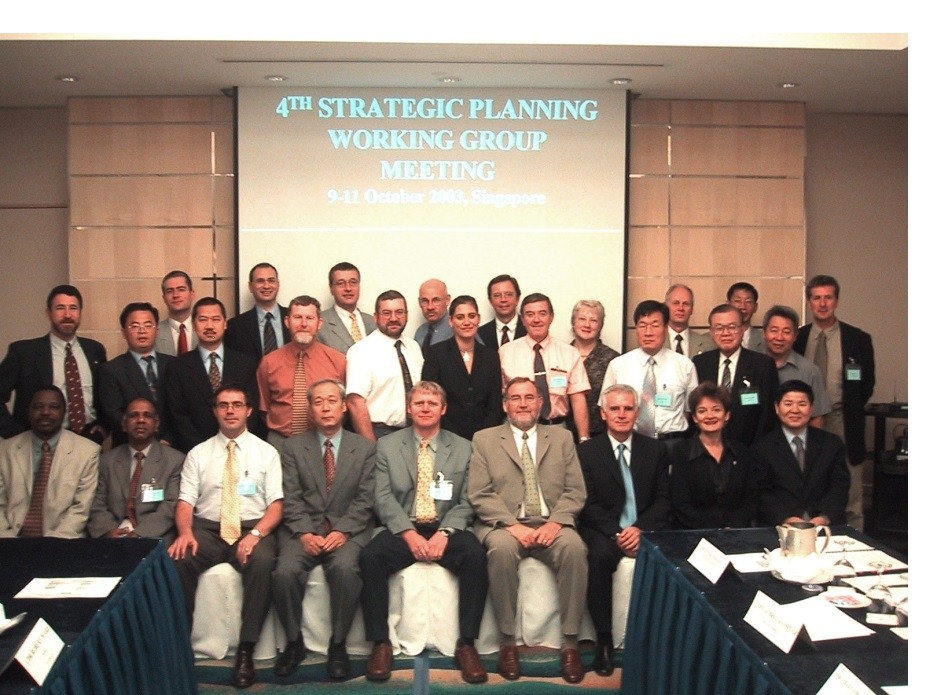
A holistic approach to the tasks was adopted to ensure a structured, logical and rigorous review. The SPWG established an image of the future IHO defined through statements of its Vision, Mission and Objectives. It determined, through a review of past documents and a survey of Member States’ opinions, what strengths and weaknesses the IHO possessed which would help or hinder it from achieving the Vision, Mission & Objectives. After assessing and debating many potential candidates for an IHO structure, the SPWG proposed a structure and a set of operational procedures which it believed were best suited to maintain the strengths, overcome the weaknesses and achieve the Mission, Vision and Objectives. It took into account the need to show increased effectiveness and cost-effectiveness and to maintain the IHO’s status as a competent international organization.
After two years of intensive work, the SPWG completed its tasks and the Chair of the SPWG submitted the Final Report to the IHB Directing Committee in April 2004. The IHB Directing Committee then issued a Conference Circular Letter (CCL-2) on 10 May 2004 and forwarded the SPWG Report and its annexed documents for the consideration of the IHO Member States. The Report included the following documents:
1. A Study into the Organizational Structure and Procedures of the IHO.
2. Convention on the IHO (Consolidated Version).
3. Draft Basic Documents (General and Financial Regulations of the IHO) (Provided Later).
4. Protocol of Proposed Amendments to the Convention on IHO.
5. Proposals to the 3rd EIHC.
The General and Financial Regulations were circulated later and provided as Information Documents, since the texts would have to be finalized after the 3rd EIHC, subject to the amendments to the Convention accepted by the Conference.
The Directing Committee invited all IHO Member States to carefully study the SPWG Report and the proposals submitted, in order to facilitate the debate, aiming to reach agreement at the 3rd EIHC, highlighting that the amendments, among other innovative ideas, proposed the following: update the objectives of the Organization, consider more frequent meetings of the Conference (every three years), establish a new organ – the Council, replace the Directing Committee with a Secretary-General and Directors, developing the IHB into the IHO Secretariat, and simplify the procedures to become a Member of the Organization.
All Member States were requested to provide their comments on the Proposals, including any alternative or amendment to the texts proposed, to the IHB by September 2004. The IHB then collated the responses and comments and circulated the “Red Book of Proposals to the 3rd Extraordinary International Hydrographic Conference” in December 2004 (CCL-12).
The 3rd EIHC held in April 2005 agreed a Protocol of Amendments to the Convention on the IHO (Decision 2). Subsequently, the 17th IHC that took place in May 2007 approved the supporting Basic Documents.

In order for the Amended Convention and the supporting Basic Documents to enter into force, the approvals of at least 48 existing Member States, being two-thirds of the Member States entitled to vote at the time of the 3rd EIHC, were required. This process, involving the approval by individual Governments and formal notification through diplomatic channels, took 11 years before the Government of Monaco was able to inform the IHB Directing Committee that it was formally notified of the approval of the 48th Member State on 8 August 2016. In accordance with the terms of the Protocol, this meant that the Amended Convention on the IHO and its supporting Basic Documents entered into force three months later, this being on 8 November 2016.
As a result of the entry into force of the revised IHO Convention and its supporting Basic Documents, a number of changes to the organization of the IHO took effect from 8 November 2016. The most significant of these changes included:
- the term International Hydrographic Bureau (IHB) used to describe the headquarters and the secretariat of the IHO ceased to be used and was replaced by the term IHO Secretariat;
- the Directing Committee, comprising a President and two Directors ceased to lead the IHB (Secretariat of the IHO). Instead, the Secretariat of the IHO was thereafter led by a Secretary-General assisted by two subordinate Directors;
- the term International Hydrographic Conference used to designate the principal organ of the Organization, composed of all Member States, was replaced by the term Assembly. The ordinary sessions of the Assembly would be held every three years instead of every five years for the Conference. The first session of the IHO Assembly (A-1) would be held in Monaco from 24 to 28 April 2017, at which time an IHO Council would be established. In order to provide a logical and sequential timetable for decision making, the first meeting of the Council (C-1) was scheduled to take place from 17 to 19 October 2017 and annually thereafter. The second session of the Assembly (A-2) would take place in April 2020;
- the subsidiary organs would report to the Council that will then refer their proposals to the Assembly or to the Member States, for adoption, through correspondence;
- the planning cycle for the IHO work programme and budget changed from a five-year to a three-year cycle. The first cycle would run from 2018 to 2020.
- for States wishing to join the IHO that are already Member States of the United Nations there would be no requirement to seek the approval of existing Member States of the IHO;
- the strict eligibility requirements for candidates seeking election as the Secretary-General or a Director were relaxed; and
- where voting by correspondence is required, through the Council, decisions would, in future, be taken based on a majority of the Member States that cast a vote, rather than the previous arrangement where a majority of all the Member States entitled to vote were required. Under the new arrangements, a minimum number of at least one-third of all Member States eligible to vote must vote positively for a vote by correspondence to stand.
In addition, a significant number of editorial amendments were required to IHO Resolutions to reflect the above and other changes. As a result, the Directing Committee presented the required consequential changes to the Resolutions (Proposal 9) to the first session of the Assembly for consideration in April 2017.