
Abstract
Preamble
The following work was presented at the Hydrographic Conference HYDRO 2024, 5–7 November 2024, Rostock-Warnemünde, Germany in the oral session Environmental and habitat mapping.
1 Introduction
Within the general effort to decrease the impact of man-caused underwater noise on the marine animal populations, the operation of active sonar systems has been, for several decades, more and more subject to regulation and control. The initial concern was the impact of naval sonars on marine mammals; it was then extended to other categories of sonar systems, now including echosounders used for seafloor mapping.
In a number of countries today, programming seafloor-mapping survey cruises (for scientific, industrial or hydrographic purposes) implies a preliminary authorization procedure based on the prediction of the field radiated by the echosounders to be operated, compared to acceptable impact thresholds established for the concerned marine animals (cetaceans in a high majority of cases) and different levels of impact (from disturbance to physical injury). These studies usually conclude to a very moderate risk level (if any), for a number of objective reasons (Lurton & DeRuiter, 2011): most echosounders transmit high-frequency signals in the upper part or beyond the animals’ auditory ranges, and attenuating very fast in seawater; the echosounder signals are very short (tens of microseconds to tens of milliseconds) although relatively narrow-band (hence non-impulsive), and are transmitted inside narrow angular sectors (typically 1°); seafloor-surveying sources are intrinsically mobile and insonify very briefly a given point. All these factors determine a sporadic time-space occupation by the echosounder radiation. After comparison with the acceptable thresholds (mainly relevant for cumulated received energy), this logically results in an absence of constraining measures for these systems.
Systematically conducted today, such risk studies are very redundant, since they always concern the same sonar systems which are actually quite few. This obviously causes a waste of time and efforts for both the applicants and the regulatory authorities: for one given echosounder the resulting conclusions are always the same and could have been established once for all through a common preliminary effort involving the regulators and the constructors.
Although the issue of acoustical noise impact on marine life is a real concern today for a number of causes (increase of the shipping traffic, offshore industry and various coastal activities), the specific case of echosounders should be reconsidered. In this respect, it is suggested that the regulatory authorities should explicitly consider the current seafloor-mapping echosounders, confirm their moderate impact according to current methodologies and standards and, when appropriate, exonerate them from preliminary impact studies. This effort could be helped by the echosounders constructors providing the necessary technical background. Such an evolution could be supported by the main actors in the field of ocean mapping (IHO, hydrographic services, public agencies, oceanography institutes…).
The present paper summarizes the fundamentals of the various issues to consider (echosounder radiation properties, currently applicable risk thresholds) and gives a simple (while sufficient) methodology and some practical results providing a basis for the approach recommended above.
2 Context
The impact of anthropogenic acoustic noise upon marine life has been a concern for more than three decades, mainly regarding marine mammals (MM). First alerts came in the 1990s, with the acknowledgement of a number of cetacean strandings caused by naval drills operating medium-frequency active sonars; these events usually concerned odontocetes, and especially beaked whales. This led to a significant effort in scientific research in this field (Southall et al., 2007), as well as first attempts of mitigation and regulation for naval sonars (TNO, 2016). In 2008, a massive stranding of melon-head dolphins trapped in an estuary in Madagascar was interpreted (Southall et al., 2013) as triggered by a distant survey operation by a 12-kHz multibeam echosounder (MBES). This event and its interpretation, causing significant reactions of the public opinion, raised suspicion about the harmfulness of low-frequency MBES, then spreading to other echosounder types. Since then, the extension of regulation and authorization procedures to more and more acoustic sources has been going on, linked to generalized environmental legislation and environment impact assessments (EIA) policies in many countries (e.g. Thomsen et al., 2021). This paper considers, from an engineering point of view, the particular field of seafloor-mapping cruises (for hydrography, science or industry purposes) operating MBES systems.
2.1 Objective quantification of auditory risks
Quantifying the acoustical impact of human activities upon marine life is an extremely wide and complex topic, restricted here to (1) marine mammals and particularly cetaceans (especially affected by acoustic phenomena and scrutinized by public opinion) and (2) multibeam echosounders (i.e. the main tool used today in seafloor mapping and especially hydrography, whose analysis can be extended to other sonar systems).
The acoustical risks quantification implies a specific analysis of the noise field at receiver; the received signals are expressed along dedicated metrics, whose comparison with admissible risk thresholds leads to conclusions about their acceptability and finally to key decisions such as cruise authorization and/or binding application of mitigation measures.
Sound levels received from a noise source are mainly expressed using two fundamental metrics (Southall et al., 2007):
- The Sound Pressure Level (SPL) is the maximum instantaneous value of the received sound pressure. Its use is especially relevant in the case of very-high-power impulsive sources such as explosions. As a sound pressure value, it expresses in dB re 1 µPa.
- The Sound Exposure Level (SEL) is the cumulated signal energy received over a reference period (conventionally 24 hours). It is well adapted to long or repetitive signals whose accumulation leads to a significant impact even for moderate instantaneous levels. Homogeneous to an energy, it expresses in dB re 1 µPa²s.
The auditory risk thresholds must be defined, in the case of marine mammals, according to various parameters:
- The animal species, defining their auditory response and frequency specialization and sensitivity;
- The received signal frequency range and its nature (impulsive or not, intermittent or continuous, wide- or narrow-band…);
- The type of risk to consider (from disturbance to physical injury) and possibly its severity level (Southall et al., 2021).
Marine mammals are classified today (NOAA, 2024) into several hearing groups: low-frequency (LFc – all mysticetes); high-frequency (HFc – most odontocetes); and very-high-frequency (VHFc – some odontocetes). Other mammals (such as sirenians, seals or bears) constitute other specific hearing groups, possibly distinguishing in-air and in-water conditions for the amphibious. They are not considered in the present work; this omission is conservative since they are less sensitive to sound impact than cetaceans.
The distinction between the various auditory groups is based on considerations on their hearing sensitivity at low level with its corresponding frequency dependence, i.e. their audiograms. In order to account for this frequency selectivity, specific weighting curves (named “M-Weighting”) are derived from the audiograms; conceptually they can be compared with the “dB-A” or “dB-C” weighting curves well known in human audiology (Houser et al., 2017). Fig. 1 depicts the M-Weighting curves computed for the three cetacean groups according to the latest reviews (NOAA, 2024) compared with the MBES frequency range (12 to 400 kHz).
2.2 Current standards for risk thresholds
The auditory risk levels associated to the reception of sound may be classified in three categories. Behavioral impact is the lowest risk level caused by sound reception. The subject receiving the sound perceives it as significant enough for triggering a reaction (usually of avoidance, but attraction is possible as well) at various levels of severity (Southall et al., 2021). No physiological degradation of the auditory system is involved in this process. The received sound property causing the reaction can be energetic (the instantaneous level, or the cumulated energy), but also linked to its content (a sound can be perceived as having an unpleasant, threatening, intriguing, appealing etc. “character”). Considering the extreme variability and generality of these concepts and their intrinsic subjectivity, no applicable quantified threshold is obtainable today from the scientific literature, although the studies in this domain are many (while these really dedicated to MBES are rather rare, see e.g. Kates-Varghese et al., 2020). It must be mentioned that two classical figures for behavioral thresholds are still in use today (NMFS, 2024): SPL = 160 dB re 1 µPa for impulsive sounds and SPL = 120 dB re 1 µPa for non-impulsive. However, considering that these levels do not depend at all on the noise properties (frequency, duration, spectral content…) neither on the animal species and auditory properties, nor on the exposure conditions, they can hardly be considered as reliable quantitative thresholds based on scientific results and usable as such.
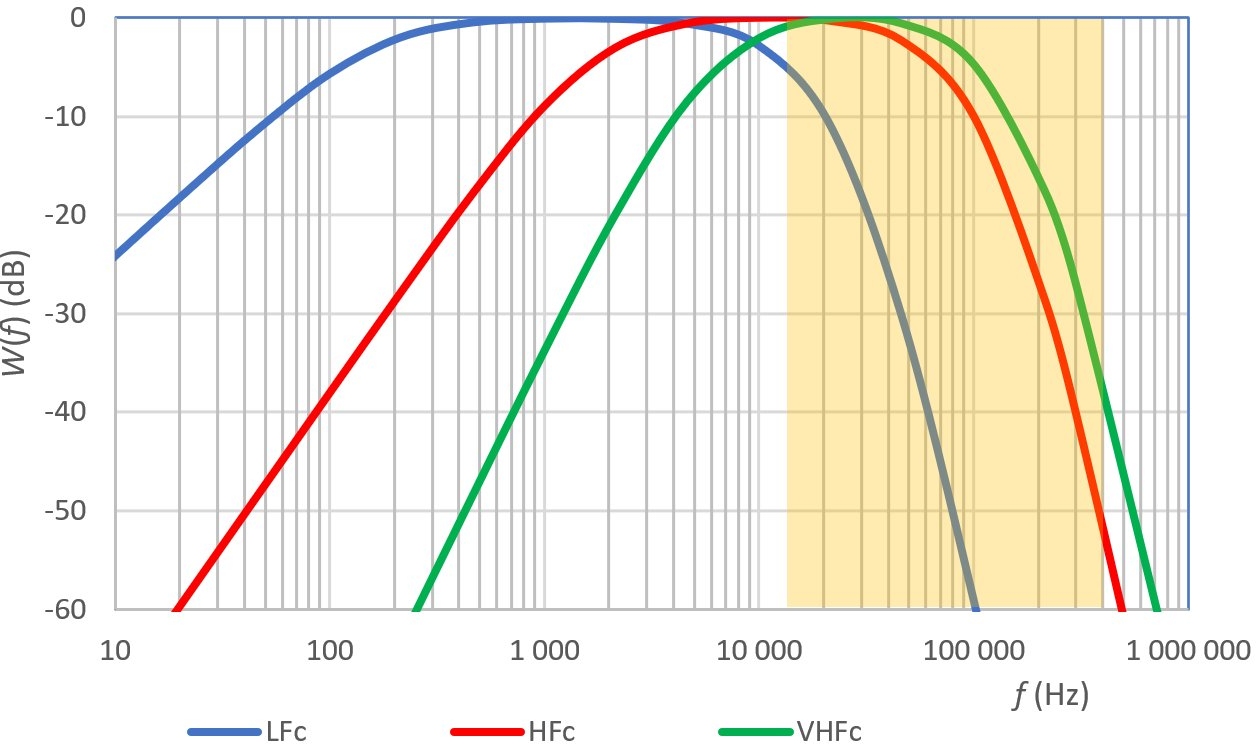
(NOAA, 2024) for details and discussions. The overall frequency range of current MBESs (12–400 kHz) is
superimposed.
A Temporary Threshold Shift (TTS) is a short-term impairment of the auditory system, caused by too intense an exposure to sound. It is commonly experimented in human audition, when a feeling of temporary deafening happens after some overexposure to noise, and disappears after a variable time lag depending on the severity of the overexposure. TTS values available for marine mammals (Finneran, 2015) result from objective measurements conducted in laboratory conditions (as well as for humans and terrestrial mammals).
A Permanent Threshold Shift (PTS) is a definitive impairment corresponding to an irreversible degradation of some parts of the auditory system. For obvious ethical reasons it cannot be measured experimentally as a provoked feature, but is extrapolated from measured TTS values (a shift of +20 dB from TTS to PTS is often admitted). Obviously, a PTS may be of various severity levels, classified in human audition from “mild” to “profound hearing loss”. In the case of MM risk assessment, the considered PTS threshold corresponds to the smaller permanent shift that can be observed (taken as -3 dB). Hence PTS in this context does not correspond to a profound impairment of the affected subject, but to the slightest level of detectable injury sequel1.
The most common criterion used today for acoustical environmental risk assessment is the PTS, due to its objective quantifiability. By definition, behavorial reactions and TTS are temporary issues, stopping after their cause has disappeared.
The latest standards available today have been compiled by NOAA/NMFS based on the state of the art of the available scientific literature (NOAA, 2024; NMFS, 2024). On this basis, Table 1 gives the TTS and PTS values for cetaceans associated to both impulsive and non-impulsive signals (the latter relevant for echosounders).

2.3 Typical requirements for risk assessment studies
The analysis needed for an auditory risk assessment study implies both a statement of the animal species and populations expected to be present on the survey area; a summary of the radiation properties of the sonars to be operated; and finally, a computation of the associated risks based on the threshold limit range determination.
From specialized databases a list must be established of the various expected species with their local density, accounting for seasonality; this makes it possible to determine the relevant risk thresholds to be applied. The sonar information must include the relevant characteristics of the source level and directivity, the frequency range covered, the transmission duration and repetition rate. The cruise program must also be established, including e.g. the planning for transmission sequences and the associated survey speeds. Finally, the insonification risks have to be computed accounting for the relevant sonar properties and applicable thresholds, basically using algorithms such as the one presented in the following. The risk assessment results make it possible to take a decision about the cruise acceptability, either without restrictions or with application of a number of mitigation measures (limitation of the source level, monitoring by specialized marine mammal observers).
2.4 Multibeam echosounders characteristics
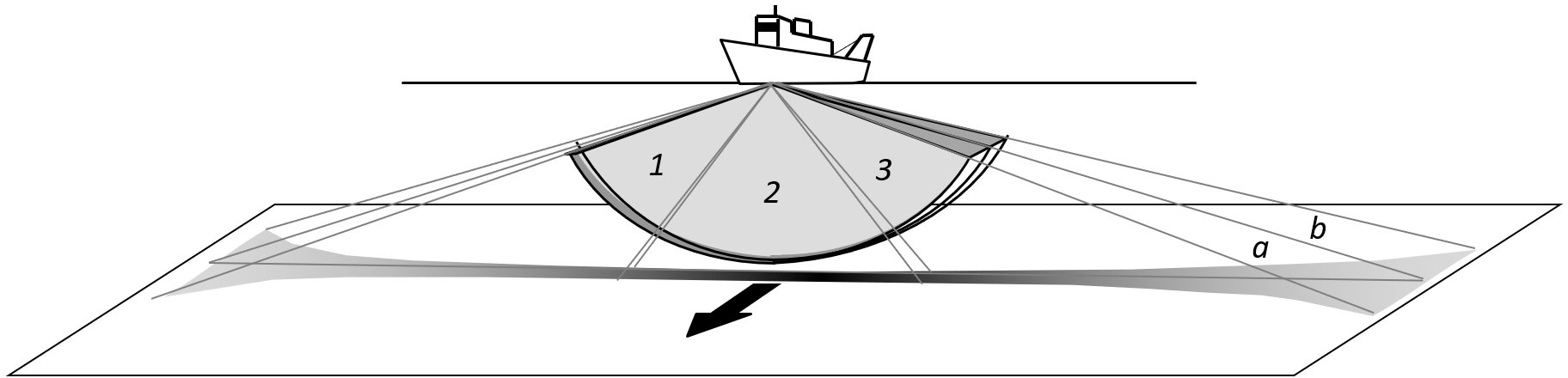
Multibeam echosounders are today the most widely used sonar systems for seafloor mapping. We will not propose a detailed description of their working principles, since only their transmitting part (Lurton, 2016) is of interest here: it always consists in a long projector array (several tens of times the acoustic wavelength) installed along the carrier vehicle axis, while relatively narrow across-ship. The purpose is to transmit the echosounder signal within a fan-shaped lobe (Fig. 2) of very wide aperture across-track (significant levels are radiated up to 60–70° on each side of nadir with a fall-off at grazing angles) and very narrow along-track (a 1° magnitude is usual). The transmission process can be split (Fig. 2) into several angular sectors across-track (in order to maximize the available power in each one) and several swaths along-track (to maximize the coverage and sounding density). However, in this angular partition the various sectors do not overlap neither in angle nor in time, so that within a ping sequence a receiving point is insonified only by one sector and one swath.
MBES systems can be declined into several categories according to their frequency range, itself related to their specialization in water depth range. Table 2 gives, for five arbitrary archetypes of MBES (Deep Water 1 & 2, Medium Deep, Continental Shelf, Shallow Water), a set of transmit characteristics derived from various constructors’ documentation and expected to be representative of current systems: frequency, source level, angle aperture, pulse duration, total transmission time (in case of multi-sector and multi-swath systems), pulse rate (for a typical water depth value). These figures are given here as representative magnitudes for typical current systems and settings; individual cases may differ from these values. Note that these are rather upper values (e.g. for source levels or pulse durations), in order to stay on the conservative side of the assessment.

The types of signals emitted by seafloor-mapping echosounders show little variety. They are most often CW pulses (a gated sine wave, with some envelope tapering smoothing the rise and decay); although their duration can be very short (tens of µs to tens of ms according to the operating frequencies) they are still tonal narrow-band signals and are not to be assimilated to impulsive signals such as blasts, shocks or airguns (Finneran & Jenkins, 2012) characterized by a very wide spectral occupation prone to cause specific auditory damages. The FM signals used to increase the operational range of MBES do not show really different properties, and are characterized by slightly longer pulse durations and a usually modest frequency sweep. Hence, risk thresholds evaluated for echosounder signals have to consider them as non-impulsive despite their short durations.
3 Modelling
3.1 Risk threshold range computation
The fundamental formula establishing the risk threshold range RRT for a given configuration (sonar parameters, cetacean group) states the equality between the received SEL and the selected risk threshold value compensated by M-weighting:
| SEL(R, f) = RT(Mm) – MW(Mm, f) for R = RRT | (1) |
written here in decibels, where SEL(R, f) is the cumulated sound exposure level at range R and frequency f of interest for the noise considered; RT is the risk threshold level upon reception, for a MM species and a given risk level (TTS, PPS…); and MW is the M-weighting factor, depending on MM species Mm, and signal frequency f.
3.2 MBES radiation regimes
As for any active sonar source, two main regimes of radiation must be considered for the sound exposure at a given receiver, namely transmission either inside the main lobe or through the lateral sidelobes. This simplifying approach is interesting both for its ease of conceptualization despite a complex radiation geometry (Lurton, 2016) and for its capacity to provide correct magnitudes in an approximate but realistic and conservative way.
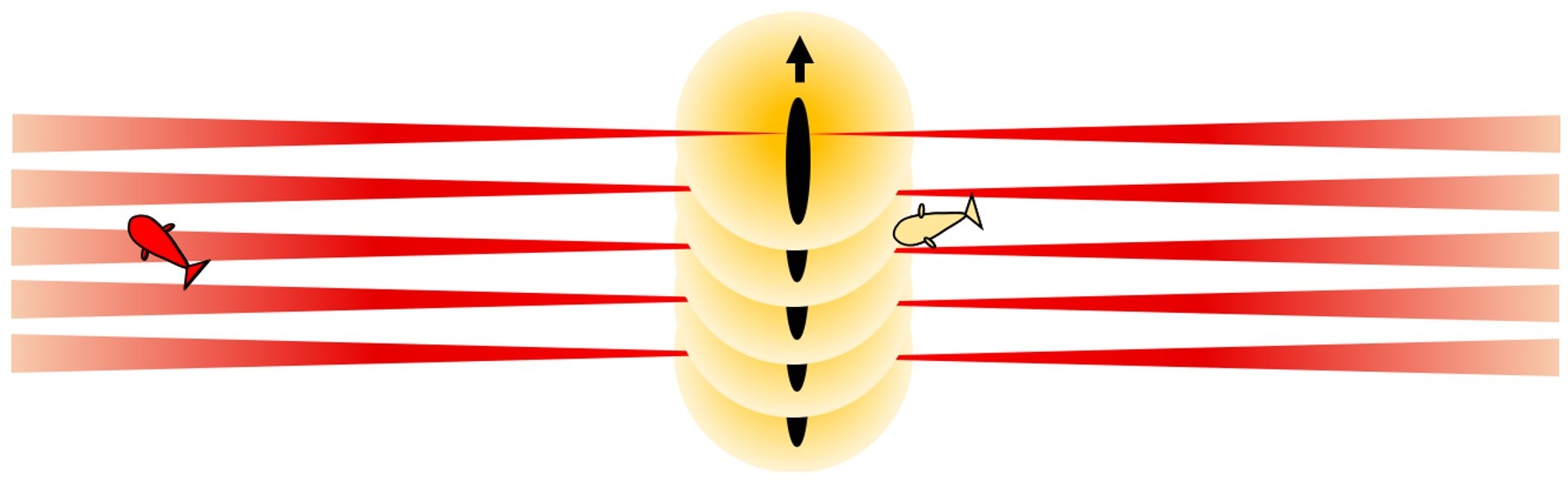
Direct Insonification – The most obvious regime is when the receiver is located inside the fan-shaped MBES main lobe radiation pattern (Fig. 3). The source level to consider then is the nominal transmit power of the sonar, and the insonification duration is the pulse length. The SEL value for this “direct” regime expresses as:
| SELD(R, f) = SL + DF + 10LogTP – TL(R, f) | (2) |
with
- SL = Sonar Source Level, in dB re 1µPa@1m
- DF = Transmit Directivity Function toward the receiver. It is simplified here to a constant 0 dB inside the main lobe, and a characteristic relative value (typically -20 to -30 dB) in the sidelobes
- 10LogTp = energy integration over exposure time Tp
- TL = 20LogR + α(f)R = transmission loss at range R and signal frequency f, α(f) being the absorption coefficient in dB/m. Note that, at short ranges from the source, a different TL expression accounting for the near-field effect must be considered (see below).
A key particularity of this main-lobe direct-exposure case is that it happens only once (if ever) for a survey line close to a fixed receiver, since the MBES transmit beam is very narrow and intersects only once per ping any point of the nearby medium, accounting for the sonar platform motion ahead. The insonification probability decreases at short ranges and for slow ping rates (and/or high speeds), as it can be shown from an elementary geometrical description (see a sketch in Fig. 3).
Near-field propagation losses in the main lobe – Due to their very long dimension relatively to wavelength making their angular aperture magnitude around 1°, MBES transmit at short ranges in the “near-field” regime (Lurton 2010). Beyond a limit range defined at frequency f as the “Fresnel range” or “far-field range” and given by RFF = L²/λ where L is the array length and λ the signal wavelength, the propagation follows the classical spherical law in 1/R²; however, below this limit range the propagation follows a cylindrical variation in 1/R. The transmission loss writes then under the generalized form:
| TL(R, f) = 10Log(R xmax(R, RFF(f)) + α(f)R | (3) |
For a 1° aperture, the Fresnel range RFF(f) equals approximately 400, 150 and 70 m for frequencies 12, 33 and 70 kHz. The near-field effect will be considered only in the computations related to insonification in the main lobe; for the sidelobe radiation the spherical regime is considered.
Sidelobe insonification – Since the sidelobes radiate all over the angular space surrounding the main lobes (in first approximation at a constant level) they are prone to insonify the receiver at each ping whatever its position. If they are considered, in first approximation, to radiate with a roughly constant level (Lurton 2015) there is no angular dependence and the only parameter is then the sonar-receiver range which is prone to change from ping to ping. In the usual seafloor-mapping configuration of an infinite survey line passing by the receiver at a minimum range Rm, it can be shown that the cumulated SEL can be approximated by the expression (Lurton, 2016; NOAA, 2024):
| SELcum(Rm) = SLSL + 10Log10[π/V/RmxTT/Tr] | (4) |
with
- SELcum the SEL cumulated along the survey line
- SLSL the source level provided by the sidelobes;
- V the sonar speed in m/s, assumed constant;
- TT/Tr the duty cycle, or the ratio of the total transmitted pulse length to the time interval between two ping sequences (see Table 2).
3.3 Model validity: a conservative approach
Although deliberately simplified, the above modelling provides a solid basis for risk assessment studies. The MBES radiation characteristics result from a thorough analysis of more detailed approaches and knowledge (Lurton, 2016). Considering the purpose and the context of EIA studies, it is interesting to remind here three main conservative hypotheses underlying the present methodology:
The MBES properties are given for high values maximizing their potential impact; in particular the source levels and pulse lengths, without systematically representing maximum maximorum values, are taken in their upper range, while in actual situations the systems are operated most of the time at lower power adapted to the local water depth.
The risk thresholds values, proposed in (NOAA, 2024) and used here, correspond to the lowest detectable levels of impairment, either temporary or permanent.
The radiation patterns in the vertical plane (for both main lobe and sidelobes) are taken as constant with angle, while they actually decrease significantly at low grazing angles and hence minimize the SEL in the upper water layers.
The direct exposure case is admitted to happen at least once during the survey line, while this may not be the case (Fig. 3).
Two more remarks are to be done about propagation modelling applied here. For the sake of simplicity, the absorption effect in seawater was omitted in actual numerical computations, hence maximizing the predicted SEL values. Conversely, the influence of multipaths propagation is not considered, which minimizes the SEL prediction. However, considering the obtained threshold ranges (Section 4), both absorption and multipaths are obviously of low influence and neglecting them in first approximation is justified.
4 Computation results for generic representative configuration
4.1 Computation results
The M-Weighted risk thresholds (PTS and non-impulsive criteria) are compared with the SEL from MBES, and the difference is used to compute the risk threshold range RRT (accounting for the near-field effect).
Main lobe insonification – As explained above, in this case the animal is located inside the main lobe and receives one direct ping; the received sound intensity is then at its highest possible value. However, this event is very short and happens only once (if at all; Fig. 3), since the lobe aperture is very narrow and the receiver will very soon be out of it due to the carrier motion (and possibly to its own); conventionally, the number of active pings is taken here equal to unity. The risk threshold ranges are estimated using a combination of Eqs. 1, 2 and 3 above (i.e. including the near-field effect).
Sidelobe insonification – The modelling applied here was chosen to consider the cumulated exposure caused by a survey line passing close to the receiver and described by the model given in (Eq. 4). For multi-sector and/or multi-swath MBES, the effective transmission time to consider for sidelobes cumulates the durations of all the signals transmitted within one ping sequence (TT in Table 2). For the demonstrative computation presented here, we used a carrier speed of V = 4 m/s (around 8 knots), a sidelobe level by -25 dB below the main lobe, and a duty cycle of TT/TR = 1/50.
4.2 Analysis of computation results
For the two configurations presented here (insonification by one ping in the main lobe in Table 3; or by a complete survey line through the sidelobes in Table 4), the threshold ranges are null or negligible in most cases. The only exception happens for the low-frequency echosounders DW1 and DW2 and the VHF cetaceans; still in this case the threshold ranges are quite modest. In all other cases, and despite the conservative hypotheses applied (Section 3.3), the risk thresholds are never reachable.


These limited and simplified results have been presented as an illustration of what is normally obtained from a risk assessment study conducted preliminarily to a survey cruise operating MBES. To summarize, two cases can be considered:
Higher-frequency MBES (above 70 kHz), used for seafloor mapping over the continental shelf (depth smaller than 200 m) and shallow water, as well as prone to be installed on deep vehicles (ROVs and AUVs) cannot cause SELs exceeding the today’s admissible thresholds (NOAA, 2024), whatever the cetaceans auditory class. This results from the fact that these sonars transmit at relatively modest levels (compared to lower-frequency systems) and with very short pulses inside a small number of angular sectors. Moreover, beyond 150–200 kHz their frequency is expected to exceed the auditory range of all marine mammals (Fig. 1). It is also reminded that high-frequency sound is submitted to a fast decay when propagating in seawater (magnitudes from 30 dB/km at 100 kHz up to 100 dB/km at 400 kHz); however, the very short ranges obtained in the computation results above do not give the absorption effect a significant role.
Lower-frequency MBES (below 70 kHz), used for mapping the deep ocean and the continental slopes, raise a limited risk, if any. Indeed, they present several negative features: they transmit in the frequency range of higher sensitivity of MMs; their source levels and pulse lengths are usually high, for efficiently mapping deep seafloor; and they are little affected by seawater absorption. However, despite these concerning features, their actual risk of exceeding admissible thresholds (NOAA, 2024) remains negligible for cetaceans of the LFc and HFc hearing classes; it is noticeable, while modest, only for the VHFc cetacean class2.
5 Discussion
The environmental impact of mapping sonars (mainly echosounders) is regularly questioned nowadays. Consequently, in many countries, conducting scientific or industrial survey cruises implies a preliminary request for an authorization based on the prediction of the field radiated by the sonars to be operated, to be compared to the acceptable impact thresholds defined for the concerned marine animals (Section 2.3). Such predictions may exceed the capabilities of many labs or survey companies, especially since the input data (sonar technical information) may be hardly available. It should be much more practical that such studies are conducted once for all by the sonar constructors and/or independent instances and results made available to their customers and to regulators; the purpose is that (1) the surveyors could use these results in their authorization request applications; (2) the regulatory authorities could a priori exonerate certain sonar classes or models, considered as impactless based on these results; (3) the constructors could claim some official approval of their products in terms of noise impact. Generally speaking, this should go in the sense of a better transparency about the actual characteristics of echosounders and their potential impact.
It is hence suggested that, following the present study, a specific project of impact prediction of seafloor-mapping sonars is conducted, relying on both previously published modelling works (e.g. Lurton, 2016) completed by some more recent results, jointly with the latest available science regarding the acoustical impact of acoustical systems on marine life (e.g. Southall, 2019) and finally the latest regulatory syntheses (NOAA, 2024). This should not be limited to MBES, but extended to other mapping sonars (single-beam echosounders, side-scan sonars, sub-bottom profilers) akin to (Ruppel, 2022). In a first step, for every concerned sonar an approximate functional model will be built, in agreement with the constructor who will provide the necessary information needed for an accurate modelling (transmission beam patterns, source levels, pulse characteristics – together with relevant operating modes recommended in survey conditions). The radiation model will then be applied for computing the relevant sound field characteristics (sound pressure level SPL, sound exposure level SEL cumulated along survey lines). The results of the radiation model computations will then be compared to the various threshold values available in the scientific literature and currently applied by regulators. This comparison will lead to conclusions about the predicted impact of the studied system, in the framework of the current scientific knowledge and regulation context; note that the results will be prone to be easily adapted to possible/probable evolutions of the regulatory thresholds.
6 Conclusions
While the impact of man-caused underwater noise on marine life is today a wide topic of concern, the particular case of hydrographic echosounders deserves a special attention. Since their apparition one century ago, these systems have constantly adopted similar specific characteristics making them of low concern for marine life: short narrow-band signals at medium to high frequencies, inside downward-steered narrow sectors. Within this configuration, the animals exposure in main transmission lobe at high level is only sporadic; sidelobe insonification continuously happens but at much lower levels. Hence the chances of exceeding objective risk thresholds (such as PTS defined in particular for marine mammals) appear to be very low, if possible at all. On the other hand, behavioral reactions of animals to echosounding are certainly possible – although no consensus exists today neither on the actual significance of their impact nor even on the possibility that they could be quantified. In this context, enforcing the respect of objective physiological thresholds appears as the best option today.
While limited in its scope and methodology, the work proposed here has presented a general framework for comparing the technical characteristics of today’s echosounders and the current knowledge status (often used in a regulatory framework) about risk thresholds applicable to marine mammals. Its clear conclusions are that higher-frequency echosounders (above 70 kHz) cannot reach current thresholds, while lower-frequency systems are possibly of concern for cetaceans of the VHFc class. These conclusions do not significantly differ from those obtained previously for a similar context (Lurton & DeRuiter, 2011) despite the subsequent evolutions in echosounders properties and available scientific knowledge.
Official authorization procedures prior to conducting at-sea operations of echosounders are now enforced in many countries and are applicable to hydrographic, scientific, or industrial contexts, involving predictive studies of the possible risks of these sonar systems to marine fauna. The paradox here is that most of these studies are pointless since, as shown in the present paper, the impact of most hydrographic echosounders as expressed by current risk standards (NOAA, 2024) is negligible. Hence a high number of assessment studies are conducted yearly, always regarding the same echosounders types and models and the same marine species, and always leading to the same conclusions.
What is suggested here is that, in a near future, a concerted effort is dedicated to a systematical evaluation of the objective risk level raised by current echosounders, leading to clear conclusions about the possibility to exonerate certain classes of systems from the current regulatory constraints. This should be a joint effort between the constructors (providing detailed information about the transmission characteristics of their products) and regulators (that should endorse the results of such studies and include them in future regulations), under the scrutiny of independent instances controlling the scientific relevance of such works and ensuring the public dissemination of the results. As a preliminary, the work presented here above has proposed a methodology for such a future task, and hopefully has given first useful magnitude orders and conclusions.
References
Finneran, J. J. (2015). Noise-induced hearing loss in marine mammals: A review of temporary threshold shift studies from 1996 to 2015. J. Acoust. Soc. Am., 138, pp. 1702–1726.
Houser, D. S., Yost, W., Burkard, R., Finneran, J. J., Reichmuth, C. and Mulsow, J. (2017). A review of the history, development and application of auditory weighting functions in humans and marine mammals. J. Acoust. Soc. Am., 141, pp. 1371–1413.
Kates Varghese, H., Miksis-Olds, J., DiMarzio, N., Lowell, K., Linder, E., Mayer, L., and Moretti, D. (2020). The effect of two 12 kHz multibeam mapping surveys on the foraging behavior of Cuvier’s beaked whales off of southern California. J. Acoust. Soc. Am. 147(6), pp. 3849–3858.
Lurton, X. (2010). An Introduction To Underwater Acoustics – Principles and Applications, Second Edition, Springer-Verlag, Berlin.
Lurton, X. (2016). Modeling of the sound field radiated by multibeam echosounders for acoustical impact assessment. Applied Acoustics, 101, pp. 201–221, https://doi.org/10.1016/j.apacoust.2015.07.012
Lurton X. and DeRuiter S. (2011). Sound radiation of seafloor-mapping echosounders in the water column, in relation to the risks posed to marine mammals. The International Hydrographic Review, 6, pp. 7–18.
NMFS (2024). Summary of Marine Mammal Protection Act Acoustic Thresholds. Silver Spring, Maryland: National Marine Fisheries Service (NMFS), Office of Protected Resources.
NOAA (2024). Update to: Technical Guidance for Assessing the Effects of Anthropogenic Sound on Marine Mammal Hearing (Version 3.0): Underwater and In-Air Criteria for Onset of Auditory Injury and Temporary Threshold Shifts. U.S. Dept. of Commer., National Oceanic and Atmospheric Administration (NOAA). NOAA Technical Memorandum NMFS-OPR-71, 182 p.
Ruppel, C. D., Weber, T. C., Staaterman, E., Labak, S. J. and Hart, P. E. (2022). Categorizing Active Marine Acoustic Sources Based on Their Potential to Affect Marine Animals. J. Mar. Sci. Eng., 10, 1278. https://doi.org/10.3390/jmse10091278
Southall, B. L., Finneran, J. J., Reichmuth, C., Nachtigall, P. E., Ketten, D. R., Bowles, A. E., Ellison, W. T., Nowacek, D. P. and Tyack, P. L. (2019). Marine mammal noise exposure criteria: Updated scientific recommendations for residual hearing effects. Aquatic Mammals, 45, pp. 125–232. https://doi.org/10.1578/AM.45.2.2019.125
Southall, B. L., Nowacek, D. P., Bowles, A. E., Senigaglia, V., Bejder, L. and Tyack, P. L. (2021). Marine Mammal Noise Exposure Criteria: Assessing the Severity of Marine Mammal Behavioral Responses to Human Noise. Aquatic Mammals, 47(5), pp. 421–464. https://doi.org/10.1578/AM.47.5.2021.421
Southall, B. L., Bowles, A. E., Ellison, W. T., Finneran, J. J., Gentry, R. L., Greene, C. R., Jr., Kastak, D., Ketten, D. R., Miller, J. H., Nachtigall, P. E., Richardson,W. J., Thomas, J. A. and Tyack, P. L. (2007). Marine mammal noise exposure criteria: Initial scientific recommendations. Aquat. Mammal., 33, pp. 411–521.
Southall, B. L., Rowles, T., Gulland, F., Baird, R. W. and Jepson, P. D. (2013). Final report of the Independent Scientific Review Panel investigating potential contributing factors to a 2008 mass stranding of melon-headed whales (Peponocephala electra) in Antsohihy, Madagascar. https://iucn-csg.org/wp-content/uploads/2010/03/Southall-Madagascar-ISRP-FINAL-REPORT.pdf (accessed 15 March 2025).
Thomsen, F., Mendes, S., Bertucci, F., Breitzke, M., Ciappi, E., Cresci, A., Debusschere, E., Ducate, C., Folegot, T., Juretzek, C., Lam, F.-P., O’Brien, J. and dos Santos, M. E. (2021). Addressing underwater noise in Europe: Current state of knowledge and future priorities. Future Science Brief, 7, European Marine Board, Ostend, Belgium. ISSN: 2593-5232. ISBN: 9789464206104. https://doi.org/10.5281/zenodo.5534224
TNO (2016). Comparison of ASW sonar risk assessment and mitigation between six different nations – a report by the SDI ASRM Group. TNO Report R10570.
- Note that regulations of human audition protection (e.g. limits of exposure to noisy work environments) are usually not so protective: a permanent hearing loss is considered as significant when exceeding -25 dB.
- It should be noted in this respect that many of the VHF cetacean species are coastal species, with little chances of being submitted to low-frequency MBES survey operations conducted in deep waters.