


1 IFHS Student Award 2023
We are delighted to announce that Manuela Ammann (University of Applied Sciences Northwestern Switzerland), holding a Masters in Geomatics, has been named the recipient of the Student Award 2023 of the International Federation of Hydrographic Societies (IFHS).
The Award was presented by IFHS Chairman, David Vincentelli, at the flagship HYDRO 2023 event in Genoa, Italy, receiving a £1,500 prize and also a historic map of Genoa port provided by the Italian Navy Institute.
Nominated by the German Hydrographic Society (DHyG), Manuela is the first Swiss recipient of the IFHS Award, which she secured for her paper titled Robotic Photogrammetric Underwater Inspection of Hydropower Plants (see pp. 38–44 of this issue1) which highlighted her excellent, innovative and practice-relevant work.
The IFHS also offers a Best Student Presentation Prize, and is committed to ensuring that all HYDRO conferences continue to include sessions on education and training and an opportunity to present their work to a global hydrographic audience.
We eagerly await submissions for the next Student Awards! See all IFHS Student Award information at https://hydrography.earth/awards/.

2 IFHS empowers the younger generation – a pathway for students and trainees through the Hydrographic Professional Accreditation Scheme
Manuela’s achievement stands as a beacon of inspiration for those considering a career in Hydrography. It is highly celebrated by the IFHS and its member societies, whose fundamental mission is to support all students and trainees on their career journey. In addition to awards, prizes and opportunities at events, the IFHS offers students and trainees support through an entry-level Affiliate status of the Hydrographic Professional Accreditation Scheme (HPAS).
Raising awareness among young professionals about the importance of individual accreditation is crucial, and this Scheme enables students and trainees to demonstrate their commitment to the profession during their education and training.
This Affiliate level requires no experience. While it is not an accreditation in itself, it provides students, apprentices, survey assistants, data processing assistants and those starting out in their careers, with a crucial pathway and structured route to activate their professional development journey and work towards future individual accreditation.
In 2024, the IFHS has seen a rise in Affiliate applications to the Scheme and some previous Affiliates have begun advancing through the levels of Accreditation. This is encouraging, and we look forward to the ongoing expansion of Affiliates within the HPAS scheme.
For further information on the pathways and application process for the Hydrographic Professional Accreditation Scheme, insights into how it can empower the younger generation to progress in their early careers, and the advantages of individual accreditation, please continue reading below.
Here’s to continued excellence in the field of hydrography!
3 HPAS – The Hydrographic Professional Accreditation Scheme by the International Federation of Hydrographic Societies
In such an international branch as hydrography, the need for standards – especially in the accreditation of individual personnel – is of great importance. The recently introduced multinational Hydrographic Professional Accreditation Scheme by the IFHS, allows individuals to gain a professional accreditation based on educational qualifications, practical experience and continuing professional development (CPD). The HPAS has received recognition by the IBSC (FIG/IHO/ICA International Board on Standards of Competence) offering those without a certificate from a recognised Cat-A or Cat-B programme an alternative which increases the likelihood that individual accreditation will become more established in the professional field of hydrography.
3.1 Towards a standardised, follow-up for, and international recognition of hydrographic skills
HPAS, the Hydrographic Professional Accreditation Scheme, is the IFHS individual certification scheme, recognised by the IBSC created to follow and accredit professional hydrographers.
Multiple questions may arise regards the Scheme, such as: Why the need for a new scheme? What are the differences between HPAS and a certificate from a recognised Cat-A and Cat-B programme?
We shall first outline the differences between diploma and certification. Certificates from a recognised Cat-A and Cat-B programme are well known and accepted within the industry and beyond. This recognition is however given by the IBSC to educational programmes rather than to individuals. The individual is thus not certified but the programme. Depending on the programme the certificate, diploma or a side-letter will be issued stating that the student has completed a programme meeting the requirements for a Cat-A or Cat-B according to the relevant S5 standard of competence from the IBSC. This indicates that the holder of such a certificate has completed all the relevant theoretical competencies as listed in the S5-A or S5-B standard as well as completed a Field Training Project. It does not qualify the holder of such a degree or certificate as a competent hydrographic surveyor just yet. In effect, one might go to a completely different industry for years still holding the same degree without ever practising hydrography at all.
Certification schemes, such as the HPAS, certify the capacity of an individual to be a recognised and qualified hydrographic surveyor, not only due to their educational qualifications but also based on the technical and/or management experience gained during their hydrographic career as well as their contribution to hydrographic surveying in general. This means that accredited HPAS members (or indeed those from other IBSC recognised schemes) have demonstrated not only how to apply the theoretical knowledge in a practical environment but also that they have accumulated enough practical experience to be proficient in their work as hydrographic surveyors. This should aid employers and clients in their selection of the right person for the (hydrographic) job.
The main objectives of a certification scheme compared to a diploma or certificate from a recognised course are:
- To demonstrate the practical proficiency of a hydrographic surveyor through a documented and peer-reviewed record of experience.
- To ensure the continuous development of an individual.
- To allow individuals with a non-hydrographic educational background in a related science to be certified as a hydrographic surveyor at a certain level.
The multinational HPAS scheme is developed and maintained by the IFHS which, as a federation consists of six hydrographic societies: THS:UKI for the UK and Ireland, DHyG for Germany, HSB for Benelux, IHS for Italy, AFHy for francophone countries and HSSA for South Africa. The development of the scheme was driven by the general need for such an accreditation scheme in industry, governmental and educational/research institutions.
HPAS is not the first scheme to become certified by the IBSC. It follows the path of Canada, Australasia, and the USA in that way, with the early goal to bridge the interest of the six associated societies, becoming a multi-national standard, and with the ambition to be recognised by all other IBSC approved schemes, helping the employment of professional hydrographers worldwide and increasing the confidence of the employers and clients of hydrographic professionals.
To that effect a Memorandum of Understanding mutually recognising each other’s accreditation is in place with the Canadian ACLS International Hydrographer Certification Scheme.
3.2 How to apply for HPAS?
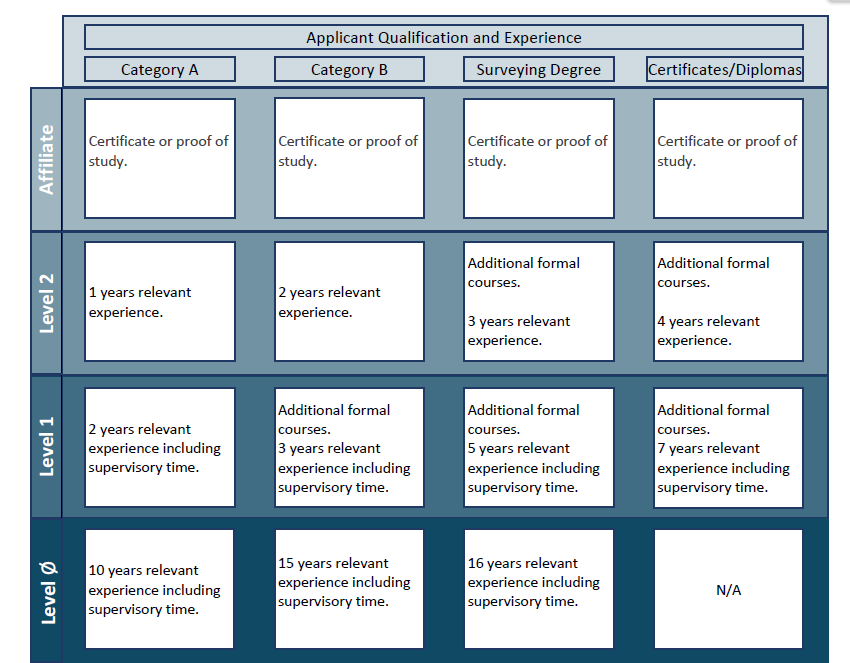
HPAS offers three levels of accreditation and an affiliate level for Students or those who have just started their career in hydrographic surveying. For each level multiple pathways are possible as shown in the illustration below. Level 2 (AH-L2) is a practical hydrographic surveyor or survey technician who can execute various survey tasks and instructions. A level 1 (AH-L1) surveyor has progressed to a supervisory/senior level and is able to plan and lead complex multidisciplinary field projects. Level 0 (AH-L0) is the highest level given to professionals who have not only advanced their knowledge but also developed management and leadership skills and become people of repute in the profession.
The exact pathway depends on the educational background and experience of the applicant. For those holding a certificate or diploma from an IBSC recognised Cat-A programme there are no further academic qualifications required for any of the pathways, they do however need to meet the experience criteria.
The minimum duration of work experience given in the illustration below must be understood as an absolute minimum. The variety of tasks and types of executed projects as well as the assigned responsibilities and roles are of greater importance.
Those holding a certificate from an IBSC recognised Cat-B programme and have the appropriate amount of experience can apply for a Level 2 accreditation. When they wish to apply for a Level 1 accreditation, they will need to demonstrate that they have obtained additional formal qualifications equivalent to those of a recognised Cat-A programme. Similarly, those entering with a degree from a programme that is not recognised will need to demonstrate their formal theoretical knowledge on a level equivalent to that of a Cat-A or Cat-B recognised programme in addition to the required amount of practical experience.
For Affiliate status, no experience is required, as this is an entry level designed for Student, apprentice, or survey assistant, data processing assistant. The affiliate status does not provide an accredited professional status but enables students and trainees to show commitment to the profession during their education and training.
To apply to HPAS, proof of educational qualifications and work experience must be provided. The required documentation varies according to the level sought and the preconditions of the applicant and may include:
- A CV with references and/or referees.
- A logbook of hydrographic survey activities covering the required amount of experience,
- Recent survey reports or products with a critique providing detailed information about the applicant’s role in the provided projects as well as an evaluation.
- An experience matrix, which lists different survey types and tasks. The applicant must indicate which kind of projects and in which responsibilities they have been involved. Depending on the level applied for, a certain number of tasks and types as well as roles are expected to be accomplished.
- A qualification mapping for those without the required certificate or degree from an IBSC recognised programme including a mapping for those applying to L1 or L0 and holding a certificate from a recognised Cat-B programme indicating how they have obtained the additional formal competencies at a Cat-A level.
- Records of Continuous Professional Development for those transitioning between levels.
- Once applications are submitted, these are reviewed by the HPAS panel. The panel consists of at least eight members from IFHS societies coming from industry, academia or government and are in office for three years. IFHS will advertise the vacant panel seats annually and nominations are then received by the HPAS steering committee, which selects the panel member. The steering committee consists of representatives of the IFHS societies and gives strategic direction and guidance to the HPAS.
The HPAS panel will scrutinise the provided information and base their decision to award or deny a certain level sought on the supplied information. In case certain aspects regards the accreditation level cannot be clarified from the provided documentation the panel may ask for additional information, contact referees or invite the applicant to an interview.
3.3 What support and guidance are available?
Support tools and events are available to guide potential candidates with their applications. A level-specific overview of necessary documents, examples of filled forms and a detailed explanation of them for each level are given in the HPAS Applicant Guide. The Panel has recently developed an Interactive Application Guide to help candidates assess their qualifications and experience to apply for the correct level. The IFHS has also just launched regular free Webinars titled ‘HPAS-Building a successful Application’, which are held in advance of each intake deadline, where attendees benefit from an overview of key information, tips, and advice along with a live Q&A and informal mentoring with the HPAS Panel. All of this information, links to the Guide, Interactive tool, webinar dates/recordings and contact details for the HPAS coordinator are all available at ‘HPAS Corner’ following https://hydrography.earth/hpas/.
3.4 When are application deadlines and what are the fees?
There are two HPAS application deadlines per year: 31 March and 31 October. The time between the application deadline and being informed about the decision might take about 15 weeks. The regular accreditation fee of 140–200 € (depending on the level sought) is reduced to 70–100 € for members of the IFHS societies. The annual renewal is 30–50 € for members.
Affiliates who are members of IFHS societies can attain Affiliate status free of charge.
3.5 How to maintain an HPAS level?
To maintain their accreditation, members must show that they have been employed in the hydrographic field for at least 6 months of the last 12 and submit a record of at least 40 hours of CPD from that year. The CPD log ensures that accredited HPAS members stay current with hydrographic developments and keep enhancing their skills. For the CPD record different professional, educational or voluntary activities related to hydrography are supported. They include non-technical skills to improve personal competencies and soft skills, as well as formal and informal time. The minimum required time of formal CPD is 20 hours per year and includes activities of structured learning that have a clear learning objective like a professional course, technical authorship, or a learning activity with assessment measures. Informal CPDs are self-managed learning like private study, on-the-job practical training, attendance at informal seminars or events focusing on knowledge sharing.
Accredited HPAS members can also transition from one level to the next after gaining more experience and educational or other qualifications. Depending on the transition level, the applicant must hand in some, or all the documents listed above for the regular application. They will also need to demonstrate that they have fulfilled all CPD requirements.
3.6 Conclusion
The first two years of HPAS operations have demonstrated the interest of public and private sector professionals to apply for HPAS accreditation. A majority of the applicants did not have a degree or certificate from an IBSC recognised Cat-A or Cat-B programme.
Within the IFHS community, accreditation of individuals is new and the Scheme needs to be advertised and Introduced further. Its successful establishment in such an internationally operating field as hydrography has a lot of benefits, especially if schemes which accredit individuals can be mutually recognised. It facilitates, for example, the staff recruitment, tenders, company-internal CPD or general administration.
The CPD requirements may well stimulate those offering training and other formal courses to consider registering the participants and issuing them with certificates stating which competencies have been covered. In addition, the international training industry offering e-learning and online trainings may develop further. They may constitute the foundation for a new international standard in the hydrographic profession which not only recognises theoretical education but also practical achievements.
- Ammann, M. (2023). Robotic photogrammetric underwater inspection of hydropower plants. The International Hydrographic Review, 30(1), pp. 38–44. https://doi.org/10.58440/ihr-30-1-a04