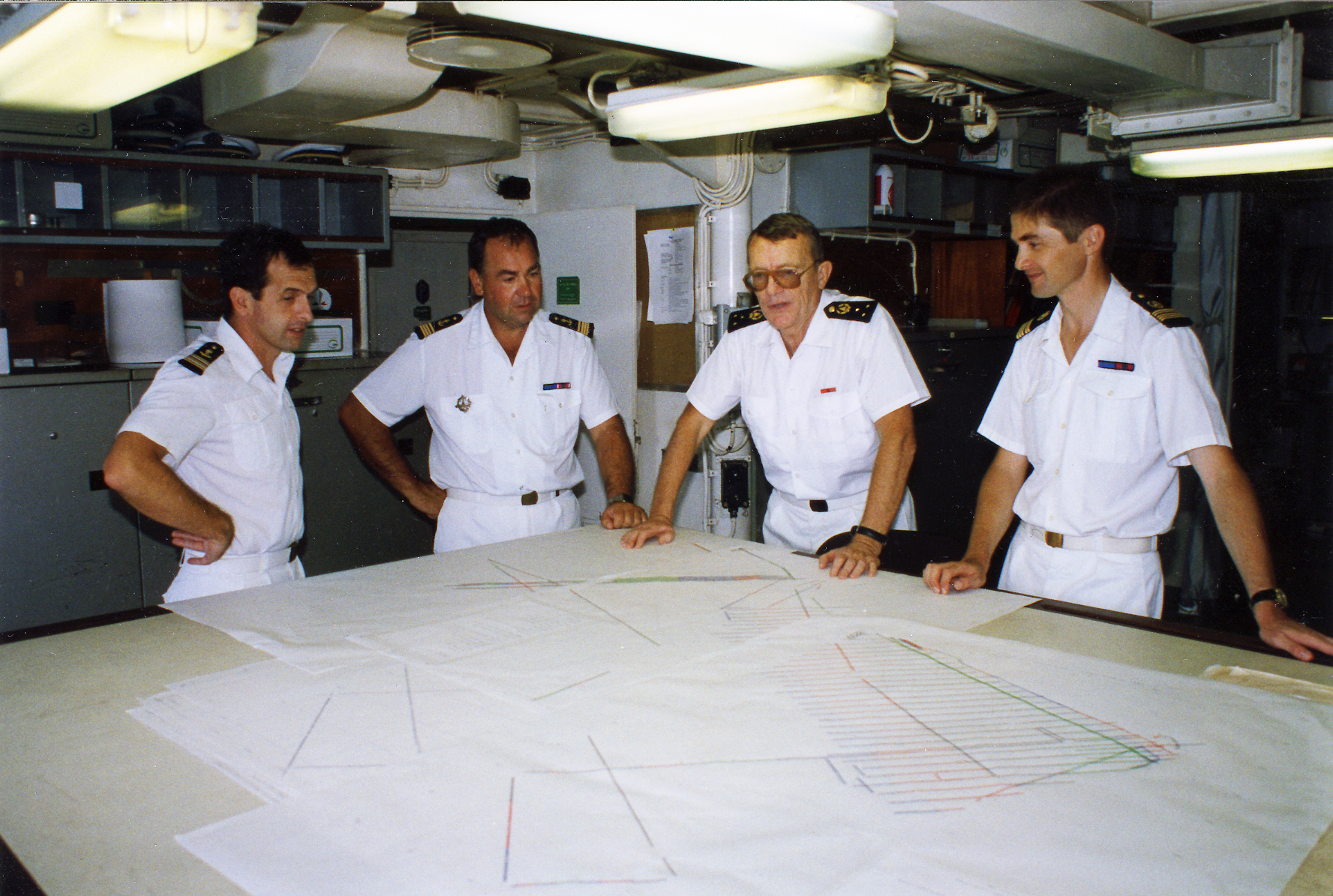
Born in Strasbourg in 1932 in a family of manufacturers, Jean-Nicolas Pasquay joined the prestigious Ecole Polytechnique in Paris in 1954 and opted for the Corps of Naval Hydrographic Engineers upon graduating, attracted by a career that combined a maritime and a scientific dimension.
His first survey experiences during his hydrographic training were along the coast of Morocco and Algeria in 1957–1958. As soon as 1961, he was entrusted to lead the special amphibious survey unit set up in 1950 to survey landing sites and was then operating on the south-west coast of France. In 1964–1965, he directed a survey campaign in the Western Indian Ocean with the survey vessel La Pérouse that focused on Madagascar and Mayotte. Back in France, he was responsible for another survey unit devoted to wreck searches from 1967 to 1969. During this assignment, he participated with the survey vessel La Recherche in the search for the French submarine Minerve that was lost in the western Mediterranean Sea in January 1968. He drew from this operation a paper on its radio positioning aspects that was presented to an international conference organized by the European Institutes of Navigation in Rome, Italy in 1970. The “wet” component of Jean-Nicolas Pasquay’s career ended with the command of the Atlantic Hydrographic Mission based in Brest, France from 1972 to 1974. With up to four survey vessels under his authority, including the newly refurbished survey vessels L’Espérance and L’Estafette, he completed the survey of the western approaches to Brest. Then he undertook the survey of the eastern part of the Channel. Close cooperation was developed with the United Kingdom Hydrographic Office for a joint survey effort in the Channel, including agreeing on a dividing line of responsibility and setting up a shared radio-positioning system covering the whole area.
After a term as Head of the Oceanography Department of SHOM Main Establishment in Brest (EPSHOM) from 1974 to 1976, Jean-Nicolas Pasquay was assigned to SHOM Head Office in Paris. Up until 1981, he was responsible for planning and monitoring the activities of SHOM units. He then oversaw prospective studies and requirement assessments and coordinated external relations, a rapidly expanding domain at the time. He contributed to the development of bilateral relations, in particular with the Hydrographic Offices of the Netherlands, Portugal and the United Kingdom. He assisted the French National Hydrographer at the 12th International Hydrographic Conference in 1982 and in the working group on election of Directors and functions of the International Hydrographic Bureau that was established by the Conference and reported to the Member States in 1985. He was the French point of contact for the understanding between Belgium, France, Netherlands and the United Kingdom on national responsibilities for hydrographic surveying in the southern North Sea and Dover Strait that was agreed in 1983. He contributed to the establishment of the Eastern Atlantic Hydrographic Commission that held its first Conference in Paris in 1986 and participated in the activities of two other regional hydrographic commissions: the North Sea Hydrographic Commission and the Mediterranean and Black Seas Hydrographic Commission.
From 1987 to 1990, Jean-Nicolas Pasquay was the Director of EPSHOM in Brest. His mandate was marked by the generalization of digital surveying and charting methods and tools, and the early studies related to electronic charts.
Appointed National Hydrographer in 1990, Jean-Nicolas Pasquay paid particular attention to the implementation of the extended national responsibilities allocated to SHOM in military oceanography. He was head of the French delegation to the 14th International Hydrographic Conference in 1992. He chaired both the Mediterranean and Black Seas Hydrographic Commission (1990–1991) and the North Sea Hydrographic Commission (1993–1994) and initiated the participation of France to the South-West Pacific Hydrographic Commission and the Meso American – Caribbean Sea Hydrographic Commission. During his last year in office, in 1994, he oversaw the contribution of SHOM to the celebrations of the 50th anniversary of the Normandy D-Day, with the publication of a commemorative nautical chart of the area, and several articles on the meteorological and oceanographic aspects of the operation.
Throughout his career and after his retirement, he was mindful of the importance of nautical charts and publications in support of navigational safety. In 1986, he published in this review an article on “Safety of Modern Shipping and Requirements in Hydrographic Surveying and Nautical Charting”. In 1992, he authored the handbook “Hydrography, nautical documents, their imperfections and proper use” still included in today’s SHOM collection of nautical publications. His conclusion “Navigation will never be a black box case” remains as relevant as ever. From 1985 to 2018, he contributed more than twenty articles on related issues in the Journal of the French Institute of Navigation together with a dozen commentaries of articles published in Seaways, the Journal of the Nautical Institute.
Pedagogue in his own way, for the benefit of the students who benefited from his geodesy class in the late 1960s–early 1970s, his subordinates in his successive assignments, his contacts in developing countries urged to consider building their hydrographic capacities, or the readers of his articles, Jean-Nicolas Pasquay combined a benevolent rigour with a subtle sense of humour that earned him the esteem of the international hydrographic community.