
Abstract
Preamble
The following work was presented at the 12th ABLOS Conference, 7–8 October 2025, Doha, Qatar in the oral session New technologies and maritime security.
1 Why “bunkering evidence” matters now
Decarbonisation compliance is no longer only about technology. It is also about proof. Regulators and markets increasingly ask two questions. What fuel was used, and what can be shown and verified. The second question is rising fast. When reported figures trigger cost, penalties, or contractual outcomes, evidence quality becomes a legal risk factor.
Three forces drive this shift. First, global policy is moving toward stronger control. The IMO’s 2023 GHG Strategy sets a clear direction toward net-zero emissions close to 2050 and calls for faster action (IMO, 2023). Second, regional regimes already convert data into consequences. In the European Union, shipping requires monitoring, reporting, and verification of emissions (European Union, 2015). FuelEU Maritime adds well-to-wake intensity requirements and links fuel choices to compliance records (European Union, 2023a). The EU also expanded the ETS (Emissions Trading System) framework and aligned key parts of its climate rules (European Union, 2023b). In these systems, a wrong number is not a small internal error. It can become a legal and financial event. Third, alternative fuels increase the distance between a physical transfer and the compliance claim. With conventional fuel oil, a bunker delivery note and a representative sample often anchor the story. With low-carbon fuels, the claim can depend on attributes and upstream steps. The evidence becomes layered. Layers create failure points. They also create disputes about who controlled what, who relied on what, and who pays.
Ammonia makes the evidence issue easy to see. Ammonia is discussed as a low or zero carbon option at the point of use, but it is highly hazardous. A minor deviation in transfer control can have immediate safety and environmental implications. A minor deviation in data can also create later enforcement and contractual consequences. LNG can act as a comparator. It shows how fuel-specific issues and emissions accounting questions can shape commercial outcomes. But ammonia is a hard case because public concern is high and the tolerance for uncertainty is low.
For the hydrographic and ocean-observation community, this matters directly. Independent observations do not replace MRV. They can strengthen accountability. They can provide time and location anchors. They can support response decisions. They can also reduce disputes by adding external, time-stamped data that is hard to rewrite after the fact.
2 The evidence stack: what data exists
Bunkering evidence is best understood as an “evidence stack”. It has four layers. Each layer has a different owner and a different audit logic. A strong system links the layers with timestamps, custody controls, and clear responsibility.
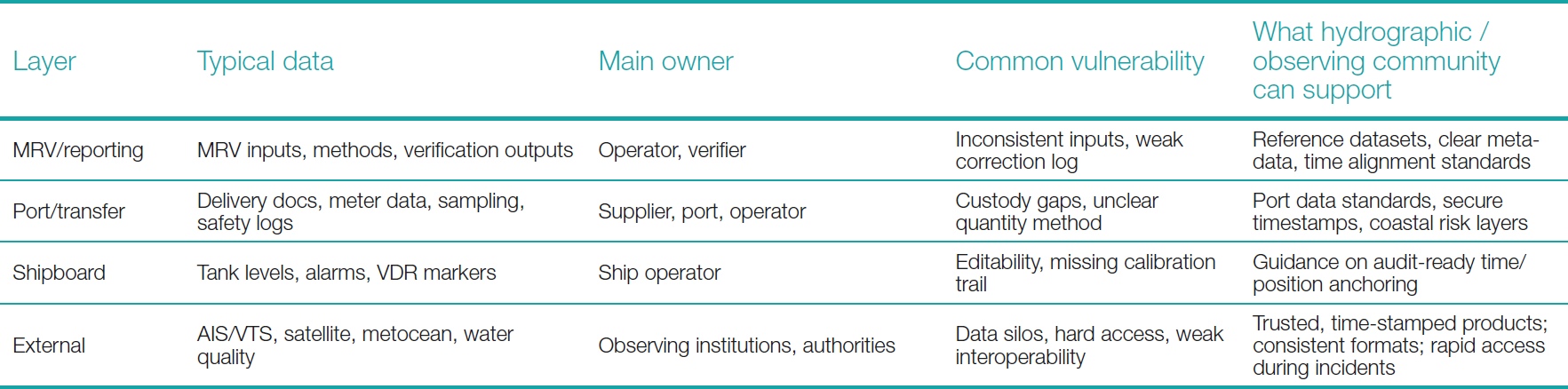
Layer 1: Regulatory reporting data (MRV and related files). MRV turns fuel use into legally relevant numbers. In the EU, the MRV Regulation establishes how emissions must be monitored, reported, and verified (European Union, 2015). FuelEU Maritime adds further requirements tied to fuel and energy use (European Union, 2023a). These rules push operators to treat data governance as compliance infrastructure. A clean MRV file requires consistent inputs, documented methods, and a traceable record of corrections.
Layer 2: Port and bunkering documents (the transfer record). This layer includes delivery documents, meter records, sampling steps, checklists, and signed logs. Under MARPOL Annex VI practice, bunker delivery notes and fuel oil sampling guidance help create a bridge between fuel supplied and compliance checks (IMO, 2024). For ammonia, operational records also include safety controls and emergency readiness. Measurement method, meter calibration, and custody seals are not “nice to have”. They are part of the proof.
Layer 3: Shipboard data (what the ship recorded). This includes tank levels, fuel management system logs, engine control records, alarm logs, and event logs. It can also include VDR (Voyage Data Recorder) time markers for key events. Shipboard data links transfer events to consumption and reporting. It also creates cyber integrity risk. If the data can be edited without trace, its legal value drops.
Layer 4: External observation data (ports, coast, and ocean). This includes AIS tracks, VTS records where available, satellite observations, coastal sensors, metocean data, and water-quality monitoring. External data can validate the time and location of the operation. It can support plausibility checks. It can also support response and post-incident reconstruction if a release is suspected. For sensitive coast operations, currents, tide, and wind can be as important as the transfer log.
Table 1 summarises owners and weak points across the stack. It also highlights where the hydrographic and observing community can add value.
The practical lesson is simple. Decarbonisation creates a multi-source truth environment. No single record will carry the whole burden. A good evidence pack aligns layers, preserves custody, and makes later reconstruction possible.
3 Where evidence fails: three predictable break points
Evidence failures cluster in three places. They are predictable, so they are preventable. Each failure point can turn a technical variance into a legal dispute.
Failure point 1: Certification and fuel attributes. Low-carbon fuels often carry claims about origin, pathway, and lifecycle emissions. For “green ammonia”, the compliance value depends on more than chemical composition. It depends on upstream production and chain-of-custody. The risk is not only fraud. It is also mismatch and non-recognition. A certificate can be valid in one system but not accepted in another. A certificate can also become detached from the physical batch if custody controls are weak. When this happens, the ship may face compliance exposure even if the transfer was safe and the fuel was fit for use.
Failure point 2: Custody transfer and measurement at the interface. The transfer interface is a classic dispute zone. Parties argue about what quantity was delivered, what quantity was received, and what method controlled the measurement. Under MARPOL Annex VI sampling practice, representative samples and linked records support compliance checks (IMO, 2024). For ammonia, the measurement and control system can differ from fuel oil routines. Small measurement differences can scale into large reporting differences when they are converted into MRV outcomes. If custody is unclear, allocation becomes unclear. Supplier, owner, charterer, and verifier can all point at each other.
Failure point 3: Onboard reporting and verification integrity. Even if the physical transfer is correct, the reporting layer can fail. Data can be incomplete, inconsistent, or not traceable back to primary records. Verification can also be too procedural. A weak audit trail makes it hard to explain deviations and hard to defend reliance. In regimes that turn reported figures into direct consequences, this becomes a core risk (European Union, 2015; European Union, 2023a). It also affects public confidence. Communities near pilot projects want proof that the operator can detect, report, and correct problems.
These failure points show why ocean-observation inputs matter. Independent data can anchor timing and location. It can support reconstruction. It can also reduce “missing facts” disputes. When facts are clearer, legal allocation is narrower and settlement is faster.
4 Legal accountability: why data integrity changes duties and outcomes
This Note stays at a high level. The goal is clarity for non-lawyers. The central point is that modern environmental governance is built on monitoring and verification. Data integrity shapes whether oversight looks credible and whether enforcement is workable.
At the international level, UNCLOS Part XII sets a general duty to protect and preserve the marine environment (United Nations, 1982). It also addresses monitoring and assessment of risks and effects. In practice, that pushes States toward systems that can observe, assess, and respond using reliable information. Due diligence is not only about having rules on paper. It is also about being able to see what is happening, to record it, and to act on it.
At the regional level, EU MRV formalises the evidence logic. Operators must monitor, report, and verify emissions under a defined system (European Union, 2015). FuelEU Maritime ties fuel use to compliance outcomes that depend on documented records (European Union, 2023a). As these systems mature, the legal risk profile changes. Data becomes economically material. That drives more disputes about reliance and proof. It also drives contract design. Parties add stronger warranties, audit rights, record-keeping duties, and correction protocols because data errors can trigger real costs.
Insurance and claims are shaped by the same logic. Claims handling depends on causation and proof. Evidence quality affects speed and cost. In alternative fuels, the “facts” often include technical and data questions, not only physical events. What was transferred. What was measured. What was recorded. What was verified. Weak records widen disputes. Strong records narrow them. This matters for compensation pathways. It also matters for public trust.
For hydrographic offices and ocean observing institutions, the accountability link is practical. Independent observations can support enforcement and response. They can also support fairness. If there is no release, external data can help show that. If there is a release, external data can help locate and model it. In both cases, observation systems are part of the evidence environment that modern decarbonisation rules increasingly assume.
5 Mini caselet: ammonia bunkering near a sensitive coast
Scenario. A port authorises a pilot ammonia bunkering operation for a coastal vessel. The transfer uses a bunker barge near a sensitive shoreline with fisheries and protected habitat. Public concern is high. The port wants a pilot that is safe and also defensible in evidence terms.
What must exist and be verifiable. Build an “audit-ready pack” using the evidence stack. Keep it time-aligned and tamper-evident.
Plan and thresholds. A documented plan for location, timing, exclusion zones, emergency steps, and clear metocean thresholds for pause or abort. Record what current, tide, and weather data sources were used and when. This matters because conditions shape dispersion and response logic.
Transfer record. Meter readings with calibration evidence. A clear method statement for how quantity is determined. A signed timeline of key steps, including connection, start, stop, and any alarms or interruptions. For ammonia, include safety checks that show control of hazardous conditions. The purpose is reconstruction. Investigators must be able to replay the event.
Shipboard record. Tank levels before and after, relevant alarms, and logs of operational deviations. If digital entries are used, keep access controls and a change log. If records can be edited quietly, they do not support due diligence.
External anchors. AIS tracks and any port traffic records for time and position. Coastal observation data during the operation window, including current and wind information. If a release is suspected, rapid water-quality observations and dispersion modelling become central. Independent data also protects the operator when there is no release.
What happens when evidence is weak. A community odor report or sensor alert can escalate fast. Weak evidence turns response into guesswork. The port may suspend pilots. Private disputes may follow. Parties can argue about what was delivered, what was measured, and who controlled the record. In an MRV-driven environment, missing audit trails can turn a manageable variance into long exposure (European Union, 2015; European Union, 2023a).
Short port lens: “port as evidence node” (Singapore as illustration). A major bunkering hub can act as an evidence node because it concentrates port records, traffic monitoring, and data exchange. Singapore is a useful illustration of this idea. The narrow point is that ports can set evidence norms. If a port requires standardised digital bunkering records, secure timestamps, clear custody transfer methods, and interfaces to reporting systems, it can reduce disputes. The caution is also clear. If data governance is weak, the port becomes a bottleneck for trust.
6 Five practical takeaways
Set a minimum evidence pack for alternative fuels. Keep it short and strict. Define required logs, timestamps, custody controls, and method statements. Make it reconstructable.
Use ocean observation as an independent anchor. Provide time-stamped metocean and coastal data that supports planning, response, and later reconstruction. Make access and formats predictable.
Treat custody transfer as a legal control point. Adapt proven discipline from MARPOL Annex VI fuel sampling practice to new fuels (IMO, 2024). Focus on custody, method, and tamper-evidence.
Design MRV integrity like a safety system. Use audit trails, access controls, and anomaly checks. If a number can trigger penalties, it deserves high control.
Make “port as evidence node” a policy goal. Ports can reduce risk by standardising digital records and aligning them with reporting regimes. This also helps public confidence in ammonia pilots.
7 Conclusion
Decarbonisation is building a new accountability environment for shipping. Bunkering is central because it turns physical reality into a compliance claim. For ammonia, the link is sharp. Safe pilots can still fail if they cannot prove what happened. Hydrographic and ocean-observation communities can help by strengthening independent anchors and supporting evidence standards that make the transition governable.
References
European Union (2015). Regulation (EU) 2015/757 of the European Parliament and of the Council of 29 April 2015 on the monitoring, reporting and verification of carbon dioxide emissions from maritime transport, and amending Directive 2009/16/EC. Official Journal of the European Union, L 123/55.
http://data.europa.eu/eli/reg/2015/757/oj
European Union (2023a). Regulation (EU) 2023/1805 of the European Parliament and of the Council of 13 September 2023 on the use of renewable and low-carbon fuels in maritime transport, and amending Directive 2009/16/EC. Official Journal of the European Union, L 234/48. http://data.europa.eu/eli/reg/2023/1805/oj
European Union (2023b). Directive (EU) 2023/959 of the European Parliament and of the Council of 10 May 2023 amending Directive 2003/87/EC and Decision (EU) 2015/1814. Official Journal of the European Union, L 130/134. http://data.europa.eu/eli/dir/2023/959/oj
IMO (2023). 2023 IMO Strategy on Reduction of GHG Emissions from Ships. Resolution MEPC.377(80), adopted 7 July 2023. International Maritime Organization, London, United Kingdom. https://www.cdn.imo.org/localresources/en/KnowledgeCentre/IndexofIMOResolutions/MEPCDocuments/MEPC.377(80).pdf (last accessed 16 February 2026).
IMO (2024). Guidelines for the sampling of fuel oil for determination of compliance with MARPOL Annex VI. MSC-MEPC.2/Circ.18, 11 July 2024. International Maritime Organization, London, United Kingdom.
United Nations (1982). United Nations Convention on the Law of the Sea (UNCLOS), adopted 10 December 1982. UN Treaty Series, 1833, p. 3.